
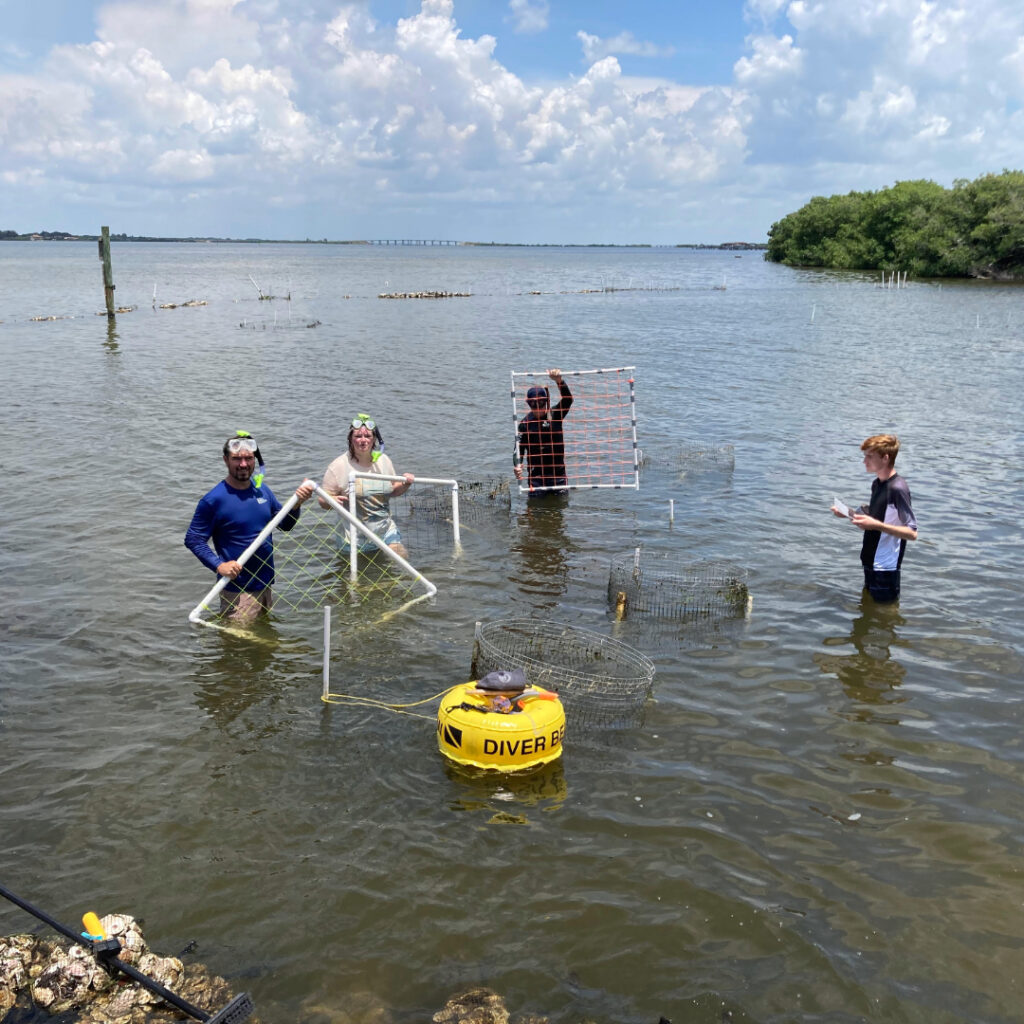
Indian River Lagoon Eyes on Seagrass volunteers. Image by Nicholas Sanzone.
Ella Armbruster is an undergraduate student the University of Florida, majoring in environmental science and minoring in zoology. Armbruster was selected as the 2025 Florida Sea Grant Community Engaged Intern (CEI). Sea Grant’s CEI program aims to broaden participation in marine and coastal professions by providing training and mentorship to undergraduate students.
Summer comes early here in Florida, and the heat only ramps up through the season. Our coastal breezes and blue waters make long days in the blistering heat bearable, and dipping into the ocean is a refreshing ritual for many.
However, spotting someone in the water might warrant a second glance. Are they carrying a pvc pipe square? A snorkel? A bucket or larger than normal measuring tape? If so, they are likely volunteers contributing to a statewide citizen science effort known as Eyes on Seagrass. The Eyes on Seagrass Program is a Florida Sea Grant program focused on seagrass conservation across several coastal counties in the state. Volunteers collect data on seagrass health, helping scientists monitor changes over time and understand the factors that affect these vital underwater ecosystems. Each region faces unique challenges, and the program adapts accordingly:
- In the Panhandle, volunteers collect a water sample to test water quality
- In Southwest Florida, volunteers collect and weigh macroalgae
- In the Indian River Lagoon (IRL), the emphasis is on documenting seagrass regrowth
Alongside Eyes on Seagrass, St. John’s River Management District (SJRMD) and the Department of Environmental Protection (DEP), work together to conduct seagrass surveys in the IRL twice a year. Last month, I had the opportunity to tag along with DEP on their summer surveys in Fort Pierce, a different region of the lagoon than what I have surveyed before. The combined efforts of survey data, aerial mapping, and citizen science data help support a network of surveillance for the health of our seagrass and lagoon.
Volunteers come from all walks of life, students, retirees, anglers, and environmental professionals. Some, like Nicolas Sanzone, have been connected to the lagoon since childhood.
“As a kid, I could not believe how many plants and animals the Indian River Lagoon supported.” said Sanzone. “I’ve seen it [seagrass in the Indian River Lagoon] ebb and flow, especially from impacts of large scale construction projects that shaped the lagoon for decades.”
Sanzone went on to study environmental science and has been very involved with seagrass, helping plant an acre with Florida Atlantic University and the Florida Oceanographic Society.
“We planted shoal grass and saw some Widgeon pop up. I helped weave the mats and monitor them and look at shoot and root growth” said Sanzone. “Projects like Eyes on Seagrass help people, including tourists, connect to something bigger.”
Others, like Mark Williams, a volunteer in Charlotte Harbor, joined the program after retiring and moving to Florida, driven by concern for the waters they fish.
“The seagrass use to be like an underwater hayfield and the fishing was spectacular. However, in a very short period of time, we just saw it go away,” said Williams.