
 Find a public pumpout, mobile pumpout vessel, or dump station by downloading the free Pumpout Nav mobile app, available on
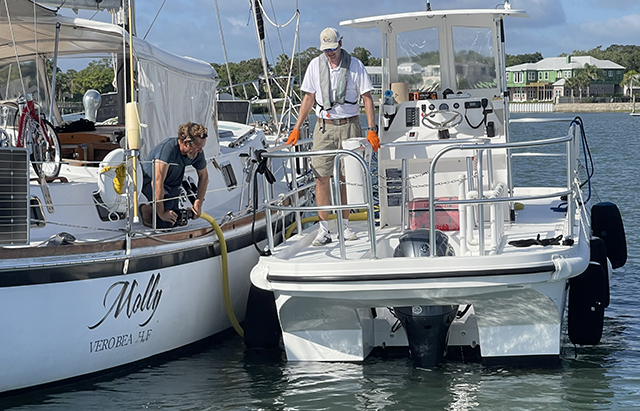
Florida has over 1,350 miles of coastline and the highest level of recreational boating in the nation. With a mild climate, diverse ecosystems, and abundant marine life, it’s no wonder why boating is on the rise in Florida.
Given the large number of boats operating in the state, even a small amount of sewage from a fraction of the boats can be harmful. Boat sewage is highly concentrated—with up to 40 times as many nutrients as raw municipal sewage. Even when treated through a type I or type II Marine Sanitation Devise (MSD), those devises are required only to reduce bacteria and solids—not nutrients—which can contribute to harmful algal blooms.
Florida Sea Grant, in partnership with the Florida Department of Environmental Protection, develops tools and resources that empower the boating community to properly dispose of waste and keep our water clean.


Raw or poorly treated sewage can spread diseases. Human waste contains bacteria, viruses, and potentially parasites. Contact with water contaminated by human waste can make you sick. Common symptoms include nausea, stomachache, vomiting, diarrhea, sore throat, earache, respiratory problems, skin infections and rashes. Serious waterborne diseases include hepatitis, typhoid, dysentery, and cholera.
Excess nutrients, like phosphorus and nitrogen, from sewage can contribute to harmful algae blooms (HABs). Boat sewage is highly concentrated and even if treated through a type I or type II Marine Sanitation Devise (MSD), it increases levels of nutrients in the water. Excess phosphorus and nitrogen from sewage can contribute to harmful algae blooms (HABs), which block sunlight penetration and contribute to lower oxygen level.
| Source | BOD mg/l | COD mg/l | TN mg/l | TP mg/l | Fecal Coliform #/100ml |
|---|---|---|---|---|---|
| Raw Boat Sewage | 3,172 | 11,136 | 1,662 | 117 | 7,500,000 |
| Raw Municipal Sewage | 242 | 463 | 38 | 5.7 | NA |
| Ratio Boat Waste to Municipal Sewage | 13.11 | 24.05 | 43.74 | 20.53 | NA |
| Table 1. Untreated boat waste pollutant concentrations compared to raw municipal sewage. | |||||
During decomposition, sewage consumes the oxygen needed by marine life to survive. When sewage breaks down, it uses up oxygen in the water. The amount of dissolved oxygen in the water required to decompose organic matter is measured in terms of “Biological Oxygen Demand” or “BOD”. Waters with high BODs and HABs make it difficult for fish and other aquatic life to survive.
Human waste discharged overboard can contaminate shellfish beds. Shellfish like clams, oysters, and mussels are filter feeders. They take in large volumes of water every day and eat the tiny food particles in the water, along with any bacteria and viruses that are present from sewage. Sewage discharged overboard can cause the closure of shellfish beds which people rely on to make a living and feed their families.
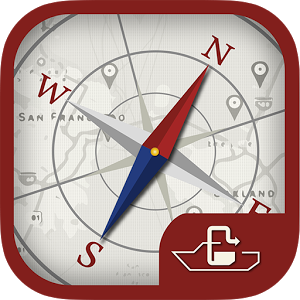
- Unscrew the deck waste fitting and make sure your holding tank’s air vent is open.
- Uncoil the hose, taking it off the pedestal to prevent blockages.
- Close the nozzle by putting the ball valve in a perpendicular position.
- Turn the pump on.
- Place the nozzle in the deck waste fitting and open the nozzle by putting the ball valve in the parallel position.
- Check the sight glass. If flow does not begin within one minute, place the nozzle in water for ten seconds. If there is still no flow, check for an air leak or clog in the hose or holding tank air vent.
- When the tank is empty, close the nozzle and angle it to the side to ‘crack the seal’ and allow any residual fluid to drain back down into the MSD.
- Rinse the pumpout system by pumping a bucket of water through the system then close the nozzle.
- Turn off the pump and return the hose so it is ready for the next boater.
Use onshore facilities before leaving the dock, at locations along the way, and when you return.
Get equipped with the sewage management option that works best for you, you can properly maintain, and will prevent waste from entering our waterways.
Don’t discharge overboard, especially in sensitive areas, over seagrass, shellfish beds, in low tidal flushing areas or near recreational swimming and fishing areas.
Pumpout regularly and use a pumpout log to keep track of your holding tank capacity.
Use the right toilet tissue. Choose rapidly dissolving paper to prevent clogging in your boat’s sewage system. Recycled paper options are available. Never flush ‘flushable’ wipes, even at home, they do not dissolve and will clog pipes.
Rinse with fresh water regularly.
Clean with a vinegar solution immediately after a tank has been emptied and before you add holding tank treatments. This reduces scale buildup, keeps the walls of the hose clean, and extends the life of the hose.
Use enzyme-based treatments over harmful chemical deodorizers and disinfectants. Enzyme treatments effectively break down solids, reduce odors, and are biodegradable and less toxic.
Clean and deodorize with borax and baking soda. Use a mix of ½ cup borax per 1 gallon of water. Clean with baking soda and water, and sprinkle baking soda around the rim.
Change hoses when needed. Over time, system hoses absorb the sewage smell. Wet a rag with hot water and put it around the hoses for a few minutes. Remove the rag, if it smells it may mean the odor has permeated through the hose and it is time to change it.
Report illegal discharges of oil, chemical and sewage spills to your local coast guard office, the national response center at 1-800-424-8802, Florida Fish and Wildlife Conservation Commission at 1-888-404-FWCC (3922), or your local law enforcement officer.
 Most boaters are familiar with the 3-nautical mile limit. That’s the typical boundary that delineates state waters from federal waters. However, did you know on the Gulf coast of Florida and Texas, state waters extend 9-nautical miles from shore?
- In any No Discharge Zone (NDZ). In Florida, NDZs include Destin Harbor, City of Key West, and Florida Keys National Marine Sanctuary.
- In any freshwater lakes, reservoirs, or other impoundments whose entrance and exits are too shallow for vessels with installed toilets to enter and leave.
- In any rivers not navigable by interstate vessel traffic (See: Federal law 33CFR 140.3(a) and 140.4)
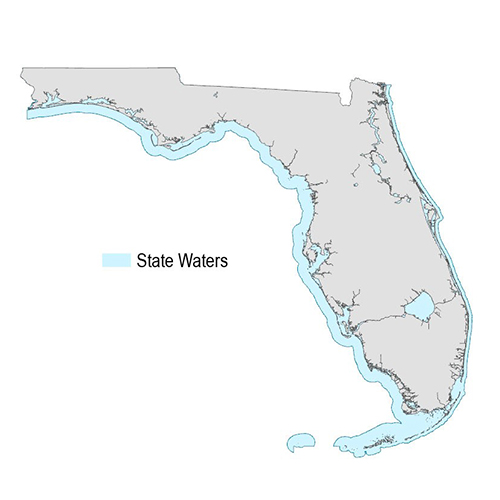 All state waters which include all inland waters and coastal waters extending roughly three nautical miles offshore in the Atlantic and nine miles offshore in the Gulf of America. State waters may be marked on you navigation charts or mapping GPS as ‘natural resources boundary.’
(See: Federal law and Florida statutes section 327.53(4)(a) and 327.53 (5))
- If you have a type III MSD (holding tank), close the Y-valve and secure it with a non-releasable wire-tie or padlock, or remove the handle entirely.
- If you have a type I or II MSD without a holding tank, close the seacock and secure it with a non-releasable wire-tire or padlock, or remove the handle, or lock the door to the head with a padlock or door handle key lock (See: Federal law 33CFR 159.7 (b)-(c)).
- Yes, if your vessel is 26 feet or more in length and has an enclosed cabin with berthing facilities. The toilet may be portable or permanently installed unless it fits one of the below descriptions.
- Yes, if you have a houseboat. It must be an installed toilet with a type III MSD, and while on state waters, the Y-valve must be set to prevent overboard discharge and locked or secured.
- Yes, if you have any floating structure with enclosed living space, with berthing facilities, or work space with public access. The toilet must be permanently installed with a type III MSD or permanently attached via plumbing to shoreside sewage disposal. (See: Florida statutes section 327.53 (1-3))
- Any vessel regardless of length may install a Type II or III MSD.
- If your vessel is 65 feet or less, you may install a Type I, II, or III MSD (See: Federal law33 CFR 159.15-159.16).
Vessels with an installed toilet must have an operable US Coast Guard certified Marine Sanitation Device (MSD). Coast Guard certified equipment can be searched for on the Maritime Information Exchange website. There are three types of MSDs.
| Type | Description | Discharge Standards | Vessel Size |
|---|---|---|---|
| Type I | Treatment devise- uses maceration and disinfectants such as chlorine | Sewage bacteria count is reduced to less than 1,000 per 100 milliliters, and there are no visible floating solids | For vessels 65 feet or less |
| Type II | Treatment devise- uses bacteria to break down the solid waste followed by disinfection | Sewage bacteria count is reduced to less than 200 per 100 milliliters, and suspended solids are no more than 150 milligrams per liter. | For vessels of any size |
| Type III | Holding tank- stores untreated sewage onboard | Cannot be discharged in state waters. | For vessels of any size |
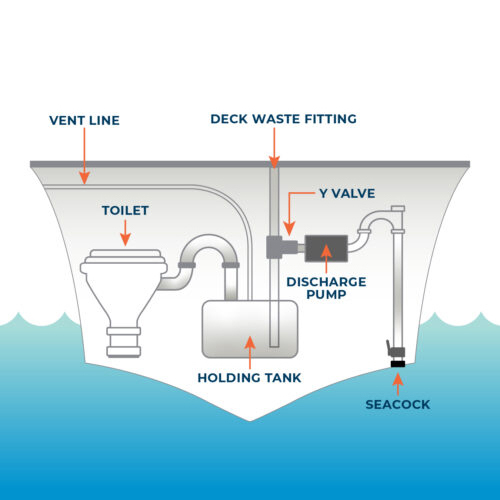
Diagram illustrating a boat’s wastewater plumbing system cross-sectioned against a water line.
A “Toilet” connects via a curved pipe into a centrally located “Holding Tank.”
From the top of the holding tank, a thin tube extends upward and runs horizontally as a “Vent Line.”
A second vertical line extends from inside the holding tank up to a “Deck Waste Fitting.”
This line passes through a “Y Valve” split.
One path of the split leads to a “Discharge Pump,” which routes waste up through a high-looped pipe and down out the bottom of the hull via a “Seacock.”
A “Toilet” connects via a curved pipe into a centrally located “Holding Tank.”
From the top of the holding tank, a thin tube extends upward and runs horizontally as a “Vent Line.”
A second vertical line extends from inside the holding tank up to a “Deck Waste Fitting.”
This line passes through a “Y Valve” split.
One path of the split leads to a “Discharge Pump,” which routes waste up through a high-looped pipe and down out the bottom of the hull via a “Seacock.”
The Y-valve is part of the MSD system, typically found on vessels with a type III MSD (holding tank). Depending on your system the Y-vale directs waste to a deck waste fitting for pumpout, to the holding tank, or overboard. Keep your Y-valve in the closed position to prevent overboard discharge.
These systems can vary greatly. Some systems do not have the typical Y-valve but instead have a discharge valve. Systems can allow for emptying the holding tank only through a pumpout via the deck waste fitting or can include an option for overboard discharge before or after the holding tank or both. Additionally, type III MSDs can be combined with a Type I or Type II MSD. Familiarize yourself with your system.
Installed toilets tend to be a bit more complicated, require regular maintenance, pumpouts, and the occasional repair. However, they are also considered the most comfortable, easy to use, and are standard on larger vessels.
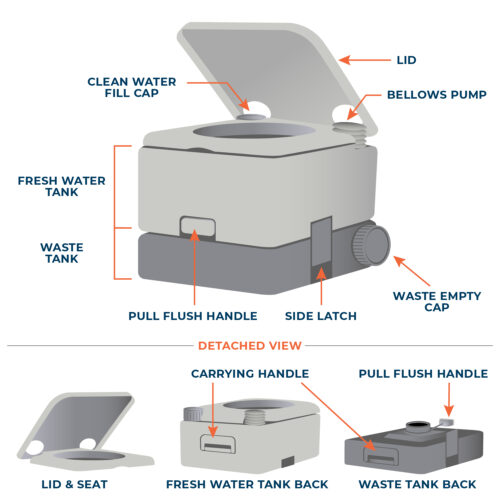
Diagram illustrating the components of a portable toilet split into two main sections.
The top section shows an assembled unit with a raised “Lid” exposing a “Clean Water Fill Cap” and a “Bellows Pump.”
The unit’s body is divided horizontally into a light grey “Fresh Water Tank” on top and a dark grey “Waste Tank” on the bottom, connected by a “Side Latch.”
A “Pull Flush Handle” sits at the center front seam, and a “Waste Empty Cap” is located on the lower right side.
The bottom section labeled “Detached View” isolates the components into three separate graphics from left to right: the “Lid & Seat,” the “Fresh Water Tank Back” featuring a “Carrying Handle,” and the “Waste Tank Back” featuring a recessed grip “Carrying Handle” and its own “Pull Flush Handle.”
The top section shows an assembled unit with a raised “Lid” exposing a “Clean Water Fill Cap” and a “Bellows Pump.”
The unit’s body is divided horizontally into a light grey “Fresh Water Tank” on top and a dark grey “Waste Tank” on the bottom, connected by a “Side Latch.”
A “Pull Flush Handle” sits at the center front seam, and a “Waste Empty Cap” is located on the lower right side.
The bottom section labeled “Detached View” isolates the components into three separate graphics from left to right: the “Lid & Seat,” the “Fresh Water Tank Back” featuring a “Carrying Handle,” and the “Waste Tank Back” featuring a recessed grip “Carrying Handle” and its own “Pull Flush Handle.”
A portable toilet is a simple, convenient, and less expensive sewage management option that requires minimal space. Due to their simple design, there is little maintenance, and it is unlikely to need repairs, saving both time and money. However, they have a limited capacity for waste so they are not ideal for long trips with multiple people.
TIP: Limited on space? Use a privacy tent or poncho for concealment.
Portable toilets should be emptied and rinsed using one of the following methods:
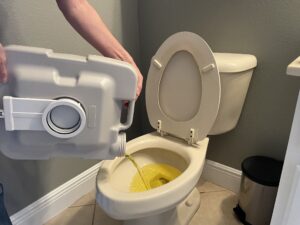 Landside Toilet
- Bring your waste tank to a landside toilet.
- Dump waste in toilet and flush.
- Rinse tank with water and vinegar and repeat as needed.
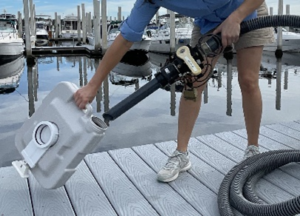 Suction Wand at a Pumpout
- Bring your waste tank & suction wand to a pumpout.
- Remove pumpout nozzle assembly (not all pumpouts allow for this).
- Clamp suction wand on pumpout hose.
- Empty waste tank with suction wand, rinse tank with water and vinegar and repeat as needed.
- When done replace pumpout nozzle assembly.
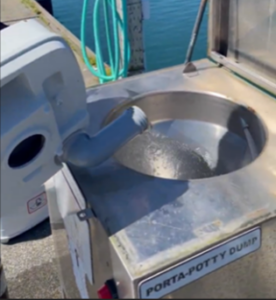 Dump Station
- Bring your waste tank to a portable toilet dump station.
- Open dump station lid & turn unit on.
- Dump waste in dump station.
- Rinse tank with water and vinegar and dump in dump station.
- When done, turn off and close lid.
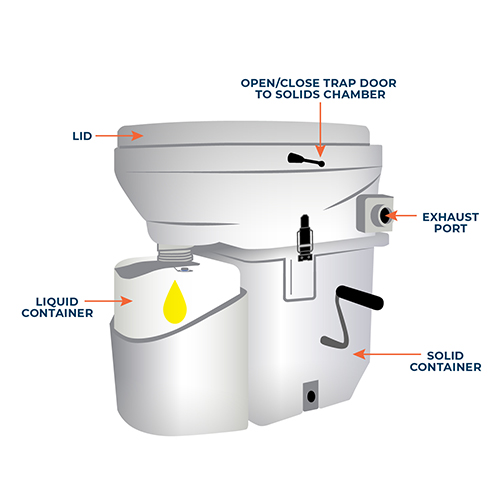
Diagram of a composting toilet detailing its primary functional parts with text labels and arrows.
The large white main structure has a top seating area covered by a “Lid” and a lower base labeled “Solid Container” with a crank handle on its side.
A semi-translucent “Liquid Container” with a yellow teardrop graphic connects to the front lower section.
An “Exhaust Port” is located on the upper right side.
A small lever on the upper front is labeled “Open/Close Trap Door to Solids Chamber.”
A central latch secures the top and bottom sections together.
The large white main structure has a top seating area covered by a “Lid” and a lower base labeled “Solid Container” with a crank handle on its side.
A semi-translucent “Liquid Container” with a yellow teardrop graphic connects to the front lower section.
An “Exhaust Port” is located on the upper right side.
A small lever on the upper front is labeled “Open/Close Trap Door to Solids Chamber.”
A central latch secures the top and bottom sections together.
Although not as common, the number of boaters opting for a marine composting toilet is on the rise. These systems are a Type III MSD and considered certified by the US Coast Guard if they meet the following requirement:
“It is used solely for the storage of sewage and flushwater at ambient air pressure and temperature”
and“Be designed to prevent the overboard discharge of treated or untreated sewage or any waste derived from sewage (Type III).”
Most composting toilets have not been examined by the US Coast Guard. Manufacturers attest that the device meets the above requirement.
Watch this video to learn more about Marine Composting Toilets and if they might be right for you.
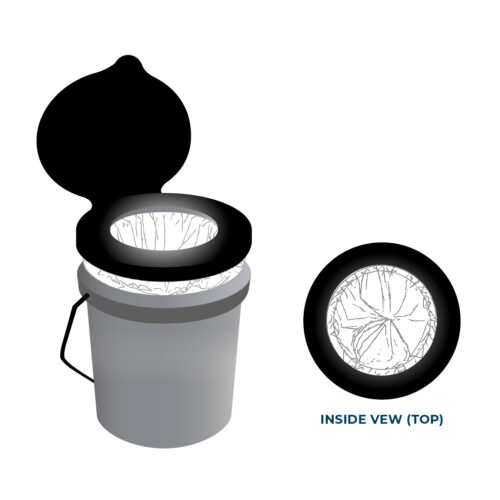
Diagram illustrating a portable bucket toilet system.
On the left, a grey five-gallon bucket with a black wire carrying handle is shown in perspective.
A black toilet seat with an attached, open lid is mounted to the top of the bucket.
The opening reveals a white plastic trash bag lining the interior and overlapping the upper rim.
On the right, an isolated circular graphic labeled “INSIDE VIEW (TOP)” provides a direct overhead perspective of the black seat rim surrounding the bunched white plastic liner at the bottom of the bucket.
On the left, a grey five-gallon bucket with a black wire carrying handle is shown in perspective.
A black toilet seat with an attached, open lid is mounted to the top of the bucket.
The opening reveals a white plastic trash bag lining the interior and overlapping the upper rim.
On the right, an isolated circular graphic labeled “INSIDE VIEW (TOP)” provides a direct overhead perspective of the black seat rim surrounding the bunched white plastic liner at the bottom of the bucket.
Although not the most glamorous of options, a bucket is good for ‘emergency’ needs, especially when taking short trips with younger children. Just make sure you have a secure lid for it. You can empty the bucket at a designated dump station, into any landside restroom, or via a suction wand at a pumpout facility. Human waste in a bucket is untreated, and it is illegal to discharge it overboard within state waters.
TIPS:
- Ensure you have a spill-proof lid.
- Don’t have a seat? Consider a pool noodle for comfort.
- Line the bucket with a bag and dispose of waste in the trash.
- Use sawdust or kitty litter to absorb liquids, but only if disposing of waste in the trash.