
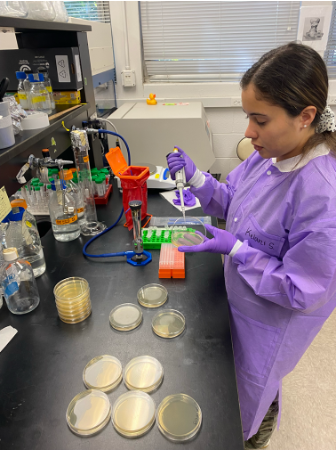
Plating dilutions of heat-treated oyster samples for incubation. In this step, it is critical to maintain aseptic techniques to avoid any cross-contamination and skew results.
Kelani Saez is a Food Science major and 2025 FSG Undergraduate Intern at the University of Florida with a strong interest in food safety and public help.
Part of the coastal Floridian experience involves enjoying oysters, raw or cooked, fresh from the sea. Oysters harvested from approved areas are generally safe to consume; however, those grown in contaminated waters should be cooked properly.
As a Florida Sea Grant–supported undergraduate intern at the University of Florida, I am currently investigating how cooking affects the survival of Vibrio parahaemolyticus in oysters. This bacterium is a leading cause of seafood-borne illnesses, and proper cooking can ensure its safety, especially among people with weakened immune systems. I conduct this project under the mentorship of Dr. Naim Montazeri and collaborate with members of his team on similar food safety projects.
Conducting this research has taught me that preparation and precision are at the heart of food safety science. Each oyster must be carefully dissected and shocked open to prevent contamination. Before performing the heat treatments, I prepare overnight bacterial inoculations, growing Vibrio cultures in a shaking incubator to the ideal concentration. Once ready, these cultures are inoculated into oyster tissue to simulate natural contamination.
I have had the pleasure of collaborating with Dr. Mohammad (Behrang) Hojjati, who recently joined Dr. Montazeri’s research team to support this project. Working with him has strengthened my teamwork and deepened my understanding of our research methods. With his guidance, we improved both the efficiency and accuracy of our experimental results, supporting one another to ensure that every experiment was performed with excellence.
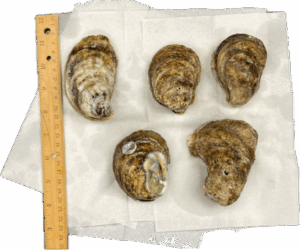
Oysters were shocked and dissected, used as samples for heat treatment in Kelani’s research.
Testing Heat and Building Skills That Matter
The foundation of my work is based on the dynamic heat treatment, which gradually raises the oyster temperature to mimic real heating conditions during cooking. I am testing various time and temperatures to achieve effective reduction in microbial loads. We use thermocouples to monitor the internal temperature of the oyster tissue, ensuring consistent and meaningful results. Each trial has been a learning experience.
I have practiced troubleshooting thermocouples, maintaining aseptic technique, cooling samples immediately after heating, and recording each step carefully in my lab notebook. I’ve discovered how small changes in timing, dilution, or sample handling can lead to very different results. This process has taught me that science is not only about data collection; it’s about developing the consistency and attention to detail that make results trustworthy.
Why It Matters to Florida Consumers
Although my project is still in progress, I can already see how this research connects to real-world food safety. Understanding how Vibrio parahaemolyticus responds to gradual heat exposure can help enhance cooking recommendations to keep oysters safe.
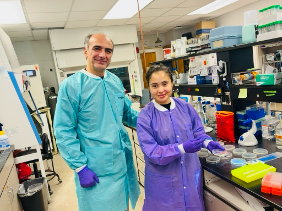
Kelani collaborating with Dr. Hojjati; learning, growing, and contributing to safer seafood cooking practices.
This experience has strengthened my interest in microbiology and food safety as a future career path. It has shown me that science can directly protect communities, prevent illness, and support Florida’s seafood industry. As I continue my work in Dr. Montazeri’s lab, I hope to further develop new skills and share what I learn to help keep seafood safe for everyone who enjoys it.
Working with Florida Sea Grant has also shown me that research is more than discovery; it is a form of service. Every step in this project, from culturing bacteria to analyzing heat resistance, brings me closer to understanding how science can protect both people and our coastal ecosystems.