
Morgan Jarrett is a member of the 2025 FSG/Guy Harvey Fellowship Cohort and a Ph.D. Candidate at Florida International University in the Department of Biological Sciences studying Predator Ecology & Conservation.
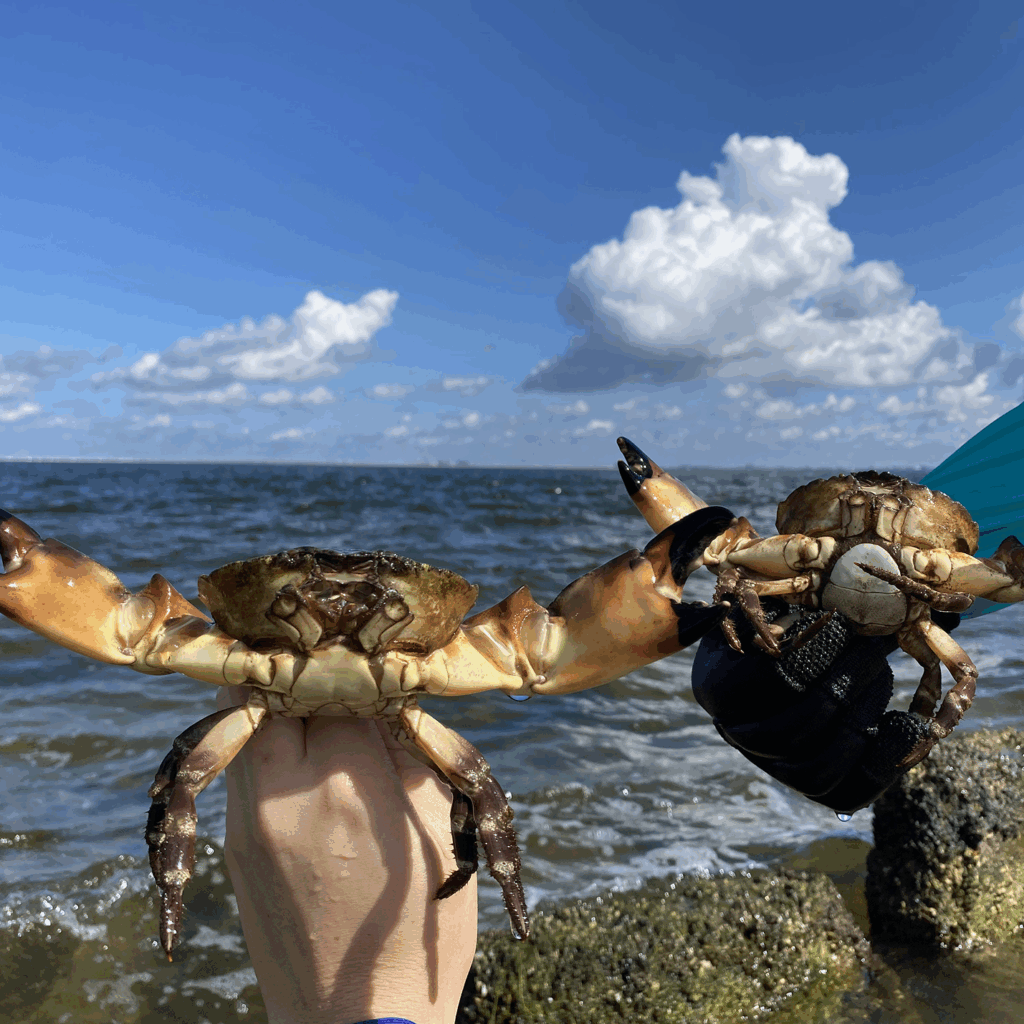
Male and Female Florida Stone Crab. Photo by Morgan Jarrett.
Celebrating a big academic achievement? Have a nice steak and lobster dinner with the family. Want to ease the conversation at a dinner party? Have a refreshing shrimp cocktail. Looking to devour the messiest meal with friends and family? Have a crab boil.
Beyond their place on dinner tables, decapod crustaceans make up a large portion of fisheries revenue globally but are often underappreciated because they are so easily available. In Florida alone, we have many well-known decapod crustacean fisheries species; two common ones are the Spiny Lobster and Stone Crab, bringing in ~$80 million USD annually.
Recently, the importance of decapod crustacean fisheries has been at the forefront of news outlets in coastal fishing areas of the United States. For example, the American Lobster fishery has experienced severe declines due to adults moving northward for cooler waters. Additionally, the Alaskan red king crab fishery and snow crab fishery have often closed due to the body size of the stock not meeting fishing regulations. As the ocean’s environments continue to change, becoming warmer and deoxygenated, the impacts on these fisheries species could prove to have substantial economic and ecological impacts.
To understand the magnitude of these potential impacts, it is important to determine the basic physiological requirements of these organisms. Due to the changes in the environment, many species that have historical data on their physiological requirements are outdated, which emphasizes the need to evaluate the new physiological “status quo” of these species. For decapod crustaceans, especially fisheries species, it is extremely important to establish the basic requirements in the current environment, behavior, and patterns of these species to better inform effective management strategies and sustainable practices.
In addition to fisheries importance, some decapod crustaceans such as the Caribbean King Crab and Long-Spined Sea Urchin are at the forefront of restoration and conservation efforts in the tropics to mitigate macroalgal growth on coral reefs by increasing the stocking of grazers on reefs. These conservation efforts must be coupled with assessments of the physiological and behavioral potential of these organisms in their environment to determine their effectiveness. My dissertation work focuses on filling these gaps in decapod crustacean fisheries and conservation research using the Caribbean Spiny Lobster and Caribbean King Crab.
Body size plays a large role in the sustainability and function of decapod crustacean fisheries. Both the spiny lobster fishery and grazer stocking efforts are also based on the animal’s body size, where the lobsters must be a minimum size to harvest, and the crabs have a minimum size for release on the reef to maximize survival. Therefore, it is important to include the role body size plays in the physiological and behavioral potential of these organisms to contextualize their effectiveness in their environment.

Morgan Jarrett holding Caribbean Spiny Lobster. Photo by Morgan Jarrett.
An important driver of physiology is morphology, or how the body is arranged. In my work, I am particularly interested in the influence morphology has on one’s physiology and how these change with body size. The morphology of an organism is extremely important when trying to understand physiological needs, as the two have evolved together to supposedly maximize the individual’s success in the environment.
In decapod crustaceans, the gills are the main morphological structure impacting an individual’s physiology. The gills are the site of gas exchange; therefore, their effectiveness is essential to the organism’s metabolic supply and demand balance. One’s metabolic demand can be measured via metabolic rate which is the rate of energy used and is often measured using a proxy like oxygen consumption. Although metabolic rate can contextualize metabolic demand, it does not account for supply; this can be done by quantifying the amount of respiratory surface (i.e., gill surface area) an individual has. This is equivalent to human lungs, where the volume determines the amount of oxygen received, and our body has a minimum amount of energy or oxygen needed to survive the day. To understand the impact morphology has on physiology, my dissertation has established the first gill surface area and body size scaling exponent for both species, along with calculating an updated scaling exponent for metabolic rate and body size in the lobsters, and the first for the crabs.
Once we understand the interaction between morphology and physiology in these species, we can then apply this information to behavioral potential for the species. For lobsters and crabs, we would expect larger individuals to get tired faster, especially since my preliminary results have indicated they have a lower metabolic rate and less gill surface area to body size ratio than smaller individuals. My dissertation examines how time to exhaustion relates to body size using chasing techniques to push the animals to exhaustion. Although they might not experience these extremes in the wild, it sheds light on their ability to do repeated highly costly activities with no breaks. As seen in some other decapod crustacean fisheries, the behavior of these animals is imperative to successful catches as changes in migration or movement patterns can cause detrimental impacts. Behavior patterns are also pivotal to grazer stocking efforts, as retention and movement on the reefs is essential to maximize effective grazing.
In summary, for these lobsters and crabs, although being bigger comes with some advantages like fighting predators and outcompeting conspecifics, it is not always better as it can leave them vulnerable to predators and less active in their environment. The results from this work funded by the Guy Harvey Fellowship will establish the new status quo for these species that can hopefully be shared with management and conservation efforts to maximize success and sustainability for the future.