
The wheel was once cutting‑edge. So was the refrigerator. Technology may feel intimidating today, but at its core, it’s simply using knowledge to improve daily life. And as Florida’s coastlines face growing pressure from pollution to population growth, technology offers practical tools to protect our communities and ocean.
Florida Sea Grant is supporting young entrepreneurs creating solutions that help coastal communities thrive. Last November, Florida Sea Grant partnered with StartGNV, a nonprofit dedicated to growing North Central Florida’s innovation ecosystem, for its first annual PitchGNV competition in Gainesville. Hosted alongside UF Innovate at San Felasco Tech City, the event spotlighted startups pushing the boundaries of ocean and environmental technology. Jessica Title, a StartGNV board member and former Florida Sea Grant award recipient for her research on ocean‑safe cosmetic chemicals, invited Florida Sea Grant to sponsor and help judge the Top Ocean Technology Team award.
Florida Sea Grant awarded four startups $500 each and the opportunity to compete for up to $10,000 in additional funding through a competitive grant process. Representing Florida Sea Grant on the judging panel, Emily Riewestahl of the Southeast Aquaculture Collaborative helped select the four awardees, each advancing to the next round of Florida Sea Grant innovation funding.
Grand Prize ($10,000 + $500 Award)
- Abdurrahman Bejjaj — Ignition Packaging
Finalist Awards ($500 each)
- Tenny Ann Dandy — Toothpik
- Ja’Rell Felix — Beachlens
- Mason Mincey — Soarce
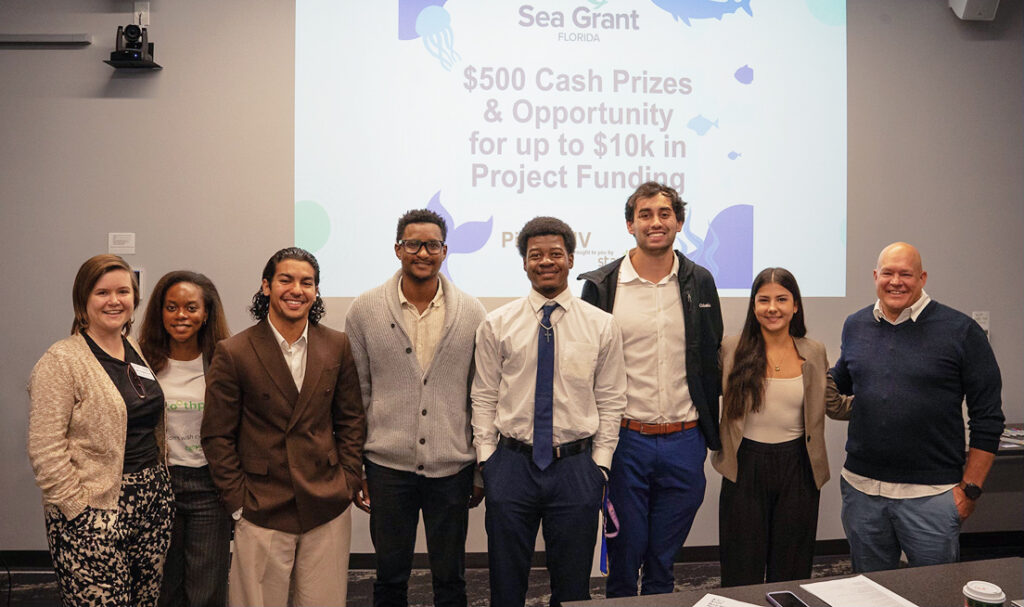
Meet the Winners
Ignition Packaging: Abdurrahman Bejjaj (University of Florida, GIS Student)
FSG Awards: $10,000 and $500
At some point, we’ve all stood over the trash can with Styrofoam takeout boxes in hand, frozen with decisiveness and guilt: “Can I recycle this?” The simple answer: no. Styrofoam cannot be recycled, so instead, it lingers in landfills and environments for centuries, breaking into microplastics that seep into our soil and waters. Plastic foam foodware are in the top ten most common types of plastic littering our beaches, totaling more than 8.7 million pieces collected since 1986.
The solution to this foamy problem? A cellulose‑based packing peanut created by Ignition Packaging, a biodegradable‑materials startup turning agricultural waste into sustainable, cost‑effective alternatives to Styrofoam. Founded by University of Florida Geographic Information Systems student Abdurrahman Bejjaj, Ignition Packaging aims to reduce plastic pollution by creating packaging solutions made from cellulose, which are the fibrous structure found in plant cell walls.
“It’s about bridging different industries to create a collective solution,” Bejjaj said. “We’re taking agricultural waste from sugar farmers, extracting cellulose, and turning it into biodegradable packaging that can compete with traditional materials while reducing environmental impact.”
Bejjaj’s interest in sustainable materials began early. At age 10, he created biodegradable plastic from milk for a science fair project, which allowed him to compete in state competitions. At the University of Florida, Bejjaj expanded that interest into a business venture, working with faculty and researchers across multiple disciplines, including UF/IFAS, to better understand the agricultural and manufacturing sectors.
After hundreds of experiments, Ignition Packaging developed a material that offers more than 220 days of shelf-life stability while fully decomposing within approximately 60 days in landfill-like environments. Ignition Packaging is initially targeting biotech and medical packaging markets, with plans to expand into food service and consumer packaged goods.
“The customers in our portfolio today are primarily biotech and medtech companies, because they have a strong need for sustainable packaging especially when selling to highly regulated EU markets. At that point, our value proposition goes beyond offering a sustainable material; we also help them avoid regulatory taxes and penalties for failing to meet ESG requirements.”
Today, Ignition Packaging has grown to a team of five, supported by a network of advisors and industry partners. The startup has earned recognition through multiple entrepreneurship competitions, including winning the ocean technology category and capturing the overall grand prize at a University of Florida pitch competition. Bejjaj believes sustainability and business can go hand in hand.
“We don’t have to create the perfect product on day one. The goal is to make an impact, continue improving, and show that sustainability can also be profitable.”
And yes, for anyone curious: you can eat the packaging. It’s not recommended as part of a balanced diet, but it’s made entirely from non‑toxic, biodegradable ingredients so you technically can.
Toothpick: Tenny-Ann Dandy
FSG Award: $500
Tenny‑Ann Dandy’s commitment to sustainability began in rural Jamaica, where she grew up surrounded by nature and a culture of resourcefulness that others might simply call recycling. For her, recycling has never been just about the environment. It is also about protecting people. That belief deepened after she witnessed a massive waste‑facility fire in Doral, Miami, that burned for three weeks and left residents struggling with asthma, air pollution, and contaminated soil and water.
“I kept asking myself, why in 2024 are we still not recycling more,” Dandy says. “I went down a research rabbit hole and found out that only about eight to nine percent of what we put in the bin actually gets recycled.”
That realization led her to create ToothPik, an AI powered app that helps people understand how to properly dispose of everyday items. Users can take a photo of anything and instantly receive guidance on whether it should be recycled, composted, or thrown away. The goal is simple: make waste diversion easier and help people build better habits.
“Most people want to do the right thing, but they do not always know how,” Dandy says. “You take a picture, and ToothPik breaks down exactly what to do with it. We want sustainability to feel simple and accessible.”
While the app currently focuses on individual users, Dandy plans to expand into schools, local governments, restaurants, and businesses. She is also building educational content, community challenges, and gamified features to make learning about waste more engaging. Through workshops and partnerships across Florida, she hopes ToothPik will not only improve recycling outcomes but also empower technology to play a meaningful role in environmental work, even if the relationship is complicated.
BeachLens: Ja’Rell Felix (University of Florida Student)
FSG Award: $500
Planning for a beach day does not always have to end in a carload of family arguments.
Growing up in coastal Fort Myers, Florida, Ja’Rell Felix saw firsthand how difficult it could be to find reliable beach information before making the trip. Hurricanes, beach closures, unsafe water conditions, and limited parking often leave visitors uncertain about what to expect upon arrival. These experiences inspired him to create BeachLens, a real-time beach information platform designed to help people plan safer and more enjoyable beach visits.
“Florida really runs on tourism, including people just taking day trips around the state,” Felix says. “If you live in Central Florida, you might drive an hour and a half for a beach day, and nobody wants to show up and find out the water’s unsafe or there’s nowhere to park. People told us stories like that all the time. So we wanted to put all that info in one place so you can make a plan before you even leave home.”
BeachLens combines data from sources such as NOAA, third-party providers, and local lifeguards to deliver live updates on beach conditions, water quality, crowd levels, parking availability, and safety information. The app also personalizes recommendations based on users’ interests, helping families, tourists, and frequent beachgoers find beaches and activities that best match their needs.
A key feature of the platform is its community-driven reporting system, which functions similarly to Waze. Users can submit real-time reports about jellyfish sightings, shark sightings, overcrowding and other conditions that may affect the beach experience, creating a more informed and connected beachgoing community.
Based at the University of Florida, BeachLens continues to expand through user research and campus outreach. The company is focused on improving access to beach safety information while building a platform that helps visitors spend less time guessing and more time enjoying Florida’s coastline.
Soarce: Mason Mincey and Derek Saltzman
FSG Award: $500
“We figured out how to turn plant waste into a material eight times stronger than steel.”
That discovery sparked Soarce, where Mason Mincey and Derek Saltzman are turning renewable resources like seaweed and silver grass into nanomaterials that could change how entire industries build things.
Mincey, a materials engineer who has worked on NASA projects and carbon fiber drone frames, kept running into the same question: why aren’t natural materials used more often, and can they ever match the cost and performance of traditional ones?
“Materials engineers often determine what materials society uses by balancing performance, cost, and environmental impact,” says Mincey. “We wanted to understand why natural materials are not used more widely. From an industry standpoint, scaling these natural solutions, cost always becomes the main issue. Will you ever get to cost parity?”
About four and a half years ago, Mincey and his team developed a process for converting plant-based resources (kelp and silver grass) into high-strength nanomaterials that can be integrated into existing manufacturing processes. Added in small amounts, these additives significantly improve the strength and durability of products.
Instead of replacing traditional materials, Soarce enhances them, helping manufacturers create stronger, lighter, and more cost‑effective components across aerospace, defense, and advanced composites.
“In many cases, manufacturers actually end up using less material overall when they use ours,” Mincey explains. “Our additive makes up less than 0.1 percent of a part’s final weight, yet increases its strength so much that they don’t need to add more material. That reduces cost and weight, and it can even improve fuel efficiency.”
Today, Soarce has a team of about 13 scientists, engineers, and business leaders focused on scaling production and commercializing the technology as the company expands its manufacturing capabilities and presenting their “stronger-than-steel” innovations across the world.