
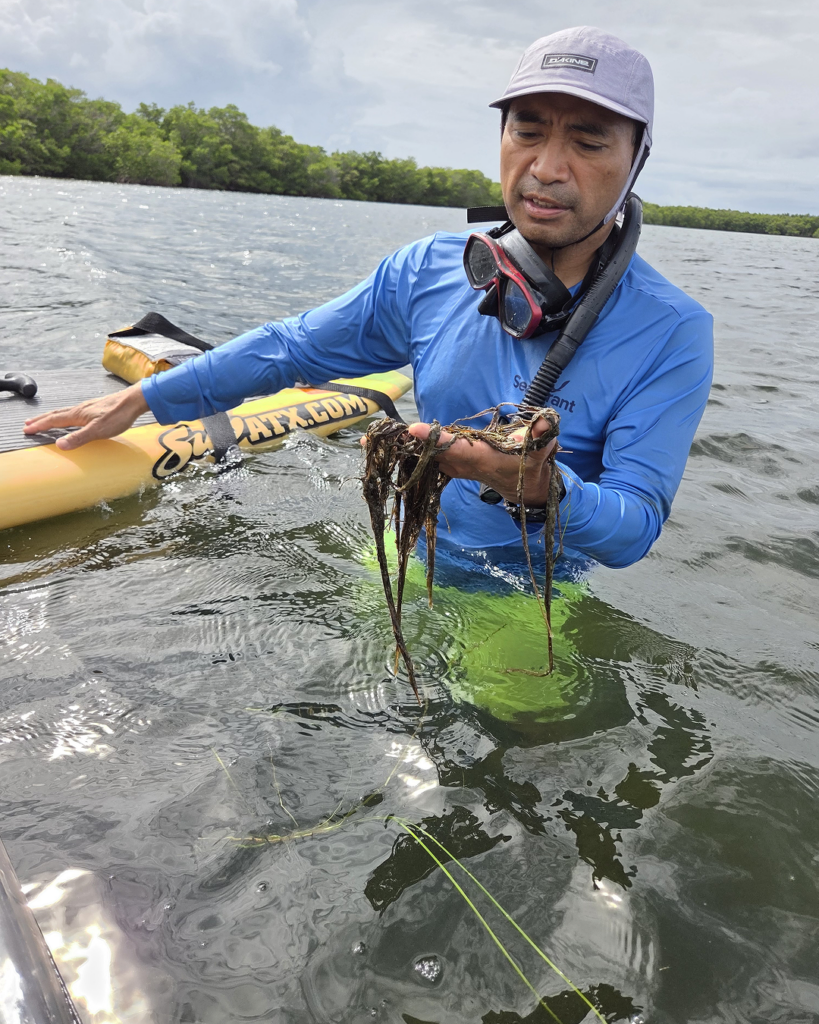
Snapshots out on the Indian River Lagoon are capturing more than just fun in the sun and water; they’re helping provide a greater understanding of effective seagrass restoration in the one of the most biologically diverse estuaries in North America. Through Florida Sea Grant and UF/IFAS Eyes on Seagrass Blitz, community members are stepping into the role of community scientists to document seagrass absence and presence in the Indian River lagoon.
Held annually, the blitz invites volunteers to take photos of seagrass, identify what they see using provided identification guides, and upload their observations through the Survey123 app or website. No specialized equipment is needed; just a smartphone and a willingness to contribute. It is so easy that Captain Frank finds no issue integrating it into his fly fishing routine.
“I usually just do the seagrass surveys while I’m out on different areas of the lagoon. I even try to get my fly fishing buddies to participate and show them how simple it is to be a part of something so positive. It gives you a good feeling knowing that you’re helping to improve the lagoon,” says Captain Frank, who is also a member of the coastal resource stewardship organization Riverside Conservancy.
Often called the cradle of the Atlantic Ocean, the Indian River Lagoon spans 156 miles across the Indian River, Banana River, and Mosquito Lagoon. Seagrass serves as a lifeline to the lagoon, providing nursery grounds, habitat, and primary food source for more than 4,000 species, including fish, invertebrates, sea turtles, and manatees. Small patches can have an outsized impact; two football fields (2.5 acres) of seagrass can support up to 100,000 fish and 100 million invertebrates.
The unique biodiversity and topography of narrow channels and artificial inlets has offered deep, place-based value for many including Captain Frank.
“I’ve been a Captain on the lagoon since 2008 but I’ve been visiting it since childhood. Growing up in central Florida, my mom would pack all the kids up on weekends and we’d go to New Smyrna beach to swim and surf, and my dad would go over to the jetties to fish,” says Captain Frank.
The lagoon is home to seven species of seagrass: shoal, manatee, turtle, Johnson’s, star, paddle, and widgeon. Together, they improve water quality by stabilizing sediments, absorbing excess nutrients, producing oxygen, and capturing carbon dioxide. However, the lagoon has lost 58% of its seagrass coverage.
The lagoon has lost 58% of its seagrass coverage.
“There was a really bad freeze in 2011, followed by a tropical storm that dumped heavy rainfall. Then the brown tide came in 2012, and that’s when the seagrass started dying. The bottom became completely barren,” say Captain Frank.
Expansive and complex, each region of lagoon faces distinct environmental pressures, resulting in various conditions of seagrass health. For scientists and resource managers, tracking where seagrass remains and where it is returning is critical to guiding restoration efforts. That’s where the Eyes on Seagrass Blitz comes in.
The results from the 2024 and 2025 blitz have already proven valuable. During last year’s Blitz, 26 teams reported 105 sightings, including seagrass in areas where it had not been reported since before the blooms. These findings were shared with scientists at the St. Johns River Water Management District (SJRWMD) to compare with their 2025 aerial surveys.
“More ‘eyes’ on seagrass in the Indian River Lagoon gives us additional data and a clearer understanding of how these habitats are recovering,” said the SJRWMD Environmental Scientists. “This can help us track changes and better understand trends across the lagoon.”
If you’re curious about how to take part in the May 1–30 Eyes on Seagrass Blitz, here are a few easy ways to get started:
Attend an in-person presentation held on Tuesday, April 21st at 2pm at the Marine Discovery Center in Volusia County. Register on Eventbrite here: https://SeagrassPresentationMDC.eventbrite.com.
If you are looking for a virtual option, tune in on April 29th at 7pm for an online webinar, via Zoom, for a webinar training. Register on Eventbrite here: https://SeagrassWebinar.eventbrite.com.
If unable to attend an in-person or virtual presentation, you can find the instructions and resources to participate via the EOS Blitz website with the link https://bit.ly/eosblitz.
“In the last four years, I’ve started seeing the seagrass come back in some very shallow areas. As we are seeing some seagrass beds established, we’re starting to see more fish, and for us fishermen, that’s what we want: more fish. We’ve seen the lagoon suffer for so long. Now that it’s improving, we want it to keep improving.”
Related
Programming
Florida Sea Grant has other seagrass monitoring programs, a citizen science program called “Eyes on Seagrass”
and an educational boating campaign called “Be Seagrass Safe.”