
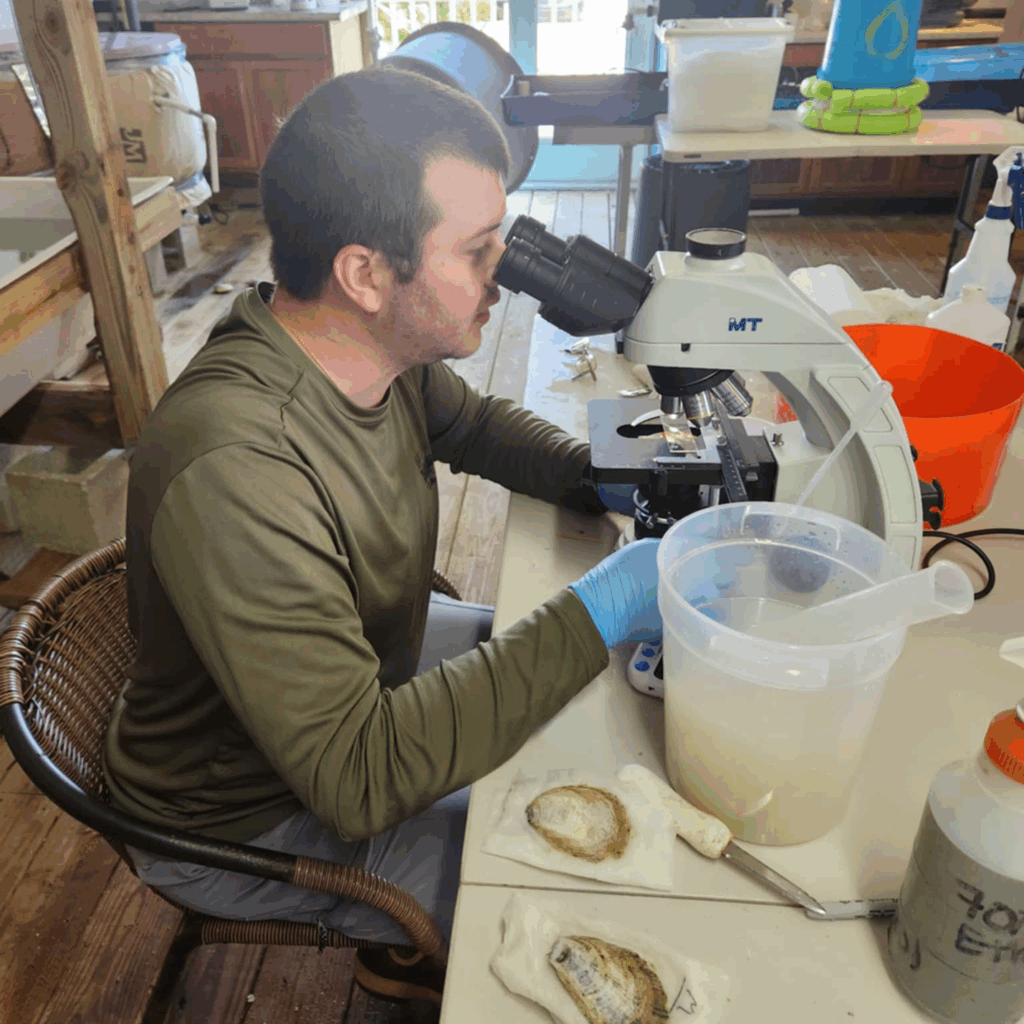
Paul McDonald is a PhD student in the fisheries and aquatic science department at the University of Florida. Paul was awarded the Aylesworth Scholarship in 2023.
“What field of marine science do you want to go into?”If someone had asked me this question 13 years ago, when I graduated high school in New Jersey, my answer would not have been working in shellfish aquaculture. It was from choosing the right community college with the right professors that helped me find my love for genetics, even though it would be another 4 years until I had a chance to use my newfound passion. As an undergraduate at Stockton University, I had the chance to work at Rutgers University over the summer in their Research Experiences for Undergraduates Program. While there, I worked with the basics of selective breeding in eastern oysters and assessed if loss of fitness or the ability for the oyster to survive could result from those practices. I was impressed with this experience as it showed that shellfish aquaculture can be easily done with a simple trip to the hardware store! My undergrad research allowed me to make connections in coastal Mississippi, where I continued my research in eastern oysters. I looked at high temperature tolerance and low salinity tolerance, attempting to find correlations between the two and assessing their heritability. I also assumed the role of being one of the lead organizers of a Gulf wide consortium, where I met my current lab. I am currently working with Dr. Huiping Yang in the Molluscan Shellfish Aquaculture and Restoration Laboratory at the University of Florida in Gainesville. Since I started, I have been able to work with many new species and branch out from eastern oysters! One species which I have been focusing a lot of my efforts on is the northern quahog, also called hard clams. Similar to oysters, they are cultured bivalves that have seen little work done to help establish lines with desired traits for things such as growth, disease resistance, and tolerance to changing estuarine conditions in Florida. Similar to farm animals, which have special functions depending on their breed, these lines are important to the aquaculture industry. By creating a line with specific functions such as growth, disease resistance, or survival for water quality issues, it would help the hundreds of Florida farmers have a safer and more sustainable crop. My first semester in the lab consisted of starting a brand new line of hard clams that would be tested for low salinity tolerance. I used my experience from my Masters and was able to create a compact recirculating aquaculture system that could hold 1,200 clams. I used clams from 4 different locations to increase the genetic diversity of the experiment and challenged the clams at 5 ppt for a total of 18 days to represent a freshwater event. I took tissue samples from all the animals to look to see if low salinity tolerance can be passed on to the next generation.
What I found out was that it can be selected for and that there are specific genes involved with low salinity tolerance that were identified in a genome-wide associated study. I was able to spawn the best survivors from the experiment and I am now working on the second generation to create a stable line for Florida clam farmers to use.
In addition to selecting for low salinity tolerance, I am also working on making a line of hard clams tolerant to high thermal temperatures. This work is important because of elevating temperatures here in Florida, especially on shallow clam leases. The design was very similar to what was done in the low salinity challenge, but we focused on the temperature and challenged the clams at 35°C. Samples were collected, sequenced, and analyzed for significant traits and correlations between traits.
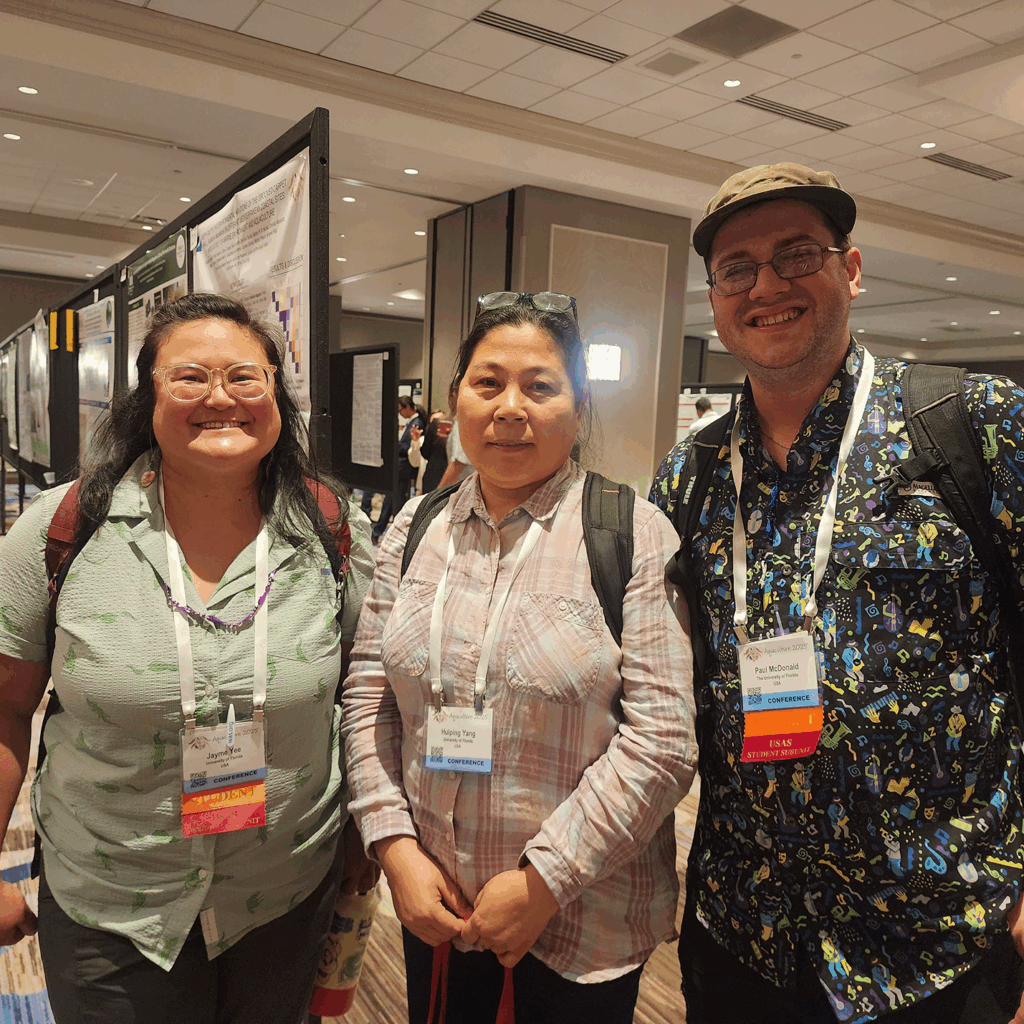
Paul (far right), with labmate Jaymee Yee (far left) and Dr. Yang-Huiping (middle) at Aquaculture America 2025.
We are currently in our 3rd generation of heat shock tolerant hard clams as once again the best surviving animals were used in making the next generation. To make sure that progress is being made, I also created two other lines for comparison purposes: one control which was never challenged and one that has been challenged once.
Other projects that I have been working on include seeing if the selection process has caused any lasting effects when compared to those not selected. I can assess this by applying a large amount of stress on the clams via starvation and looking at their immunological and histological, gene expression and nutrient composition over the course of a few months. I have also worked on eastern oyster breeding programs, freezing of tissue and cells for future use, and I am now working with a brand-new species to the lab: Florida stone crab!
The constant expansion of the lab and getting to work with all the different species has given me many opportunities to grow and learn many new skills. Every day is a new adventure as it has taken me out of my initial comfortable shell and opened me up to the world of aquaculture as a whole. It is an awesome feeling to know that my work makes a difference and helps ensure that seafood can be sustainable for years to come.