
Hallie Repeta is a Ph.D. candidate in Marine Resource Assessment at the University of South Florida’s College of Marine Science. She was awarded the Florida Sea Grant-Guy Harvey Fellowship in 2025.
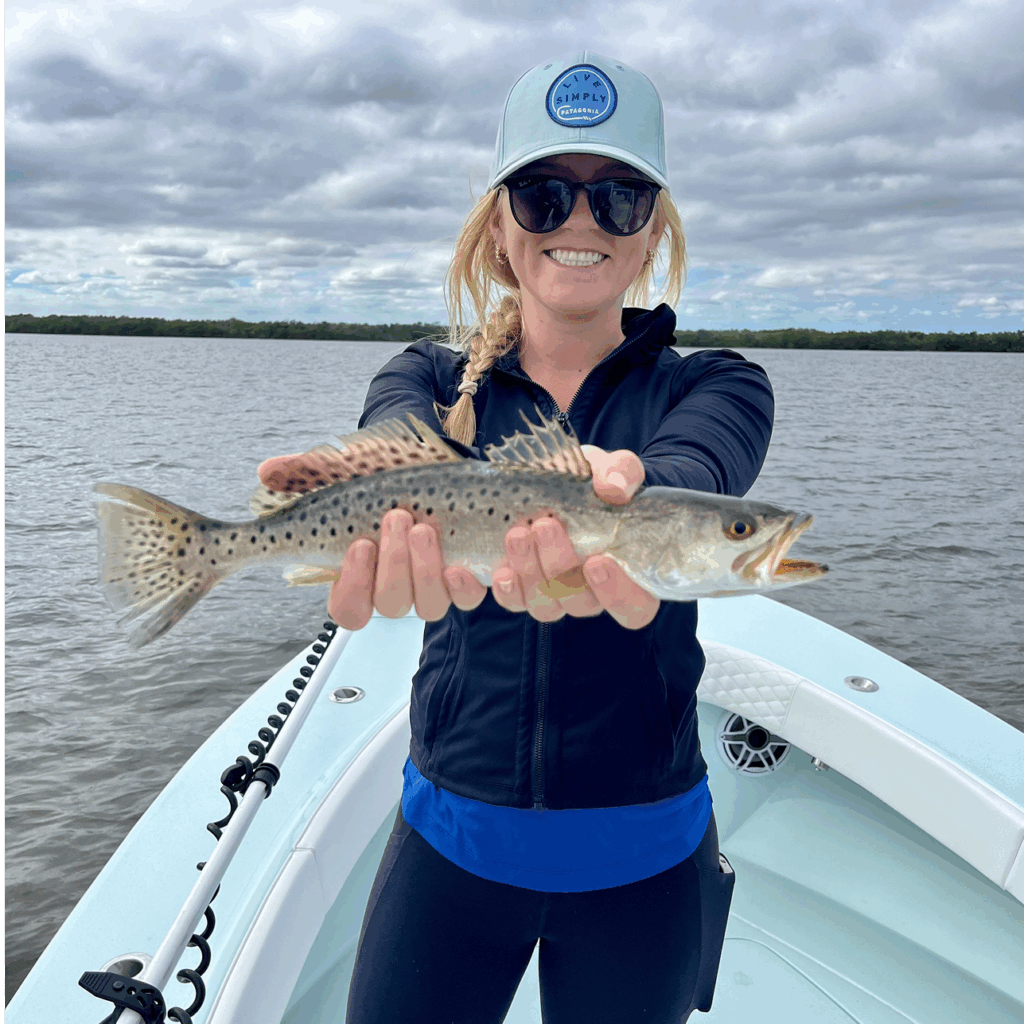
Repeta holding a Spotted seatrout (Cynoscion nebulosus) while assisting in field work in Tampa Bay. Photo by Hallie Repeta.
As a child growing up along the rocky coast of Maine, I remember spending countless hours building tide pool habitats for the crabs and critters I collected. Little did I know that those experiments —shaping habitats and watching interactions— taught me early lessons about the interconnectedness of ecosystems and would shape my career in marine science. Today, my research focuses on some of the ocean’s most overlooked yet ecologically critical residents: forage fish.
Many people often picture large, iconic species like grouper, snapper, or tuna when they think about fisheries. But the productivity of these fisheries depends on much smaller fish that rarely make the headlines like anchovies, sardines, menhaden, and other “forage fish.” Forage fish—small-bodied, mid-trophic, short-lived species—play a disproportionately large role in coastal ecosystems. These species form the foundation of marine food webs, transferring energy from plankton to the larger predators that support both ecosystems and economies.
On the West Florida Shelf, forage fish connect estuarine nurseries, coastal waters, and offshore systems, sustaining both commercial and recreational fisheries. Despite their importance and value, forage fish are often understudied and overlooked—even as pressures from fishing, nutrient pollution, and climate driven stressors threaten their populations.
My path to studying forage fish has been shaped by a mix of fieldwork, conservation internships, and data-driven research. As an undergraduate, I researched predator-prey dynamics while studying abroad in Bermuda and experienced firsthand how invasive species can destabilize marine communities. Later, my work with various marine conservation nonprofits across Southeast Asia exposed me to the challenges of managing marine protected areas and highlighted how achieving sustainable marine management requires well-coordinated scientific research, effective community governance, and open stakeholder collaboration. These experiences underscored the value of Ecosystem-Based Management (EBM), which refer to holistic management approaches that reflect the interconnectedness of ecological and socioeconomic goals.
Over time, I became drawn to quantitative analysis and ecosystem modeling as tools to bridge my passion for field ecology with broader, system-wide questions. That path ultimately brought me to the University of South Florida, where I now use quantitative tools to study how small fish sustain big ecosystems.
My research seeks to unravel the complex dynamics of forage fish on the West Florida Shelf, and focuses on understanding how forage fish support ecosystem resilience under changing environmental conditions. To achieve this, I am using a multifaceted approach: diet analysis to track energy flow through the food web, ecosystem modeling to understand how environmental variability impacts predator-prey interactions, and network theory to analyze how environmental changes reshape these ecosystem dynamics.
Ultimately, this work is building on the foundations of Ecosystem-Based Fisheries Management (EBFM), which is a shift from managing species in isolation towards managing fisheries within the broader context of ecosystems. Under the advisement of Dr. Ainsworth, our lab uses the Gulf Atlantis ecosystem model, a sophisticated end-to-end framework that integrates biogeophysical and socioeconomic processes. Ecosystem models like Atlantis are central to implementing the approaches of EBFM. They allow us to simulate realistic ecological processes, integrate diverse datasets, and test management or environmental scenarios that cannot be replicated in the field.
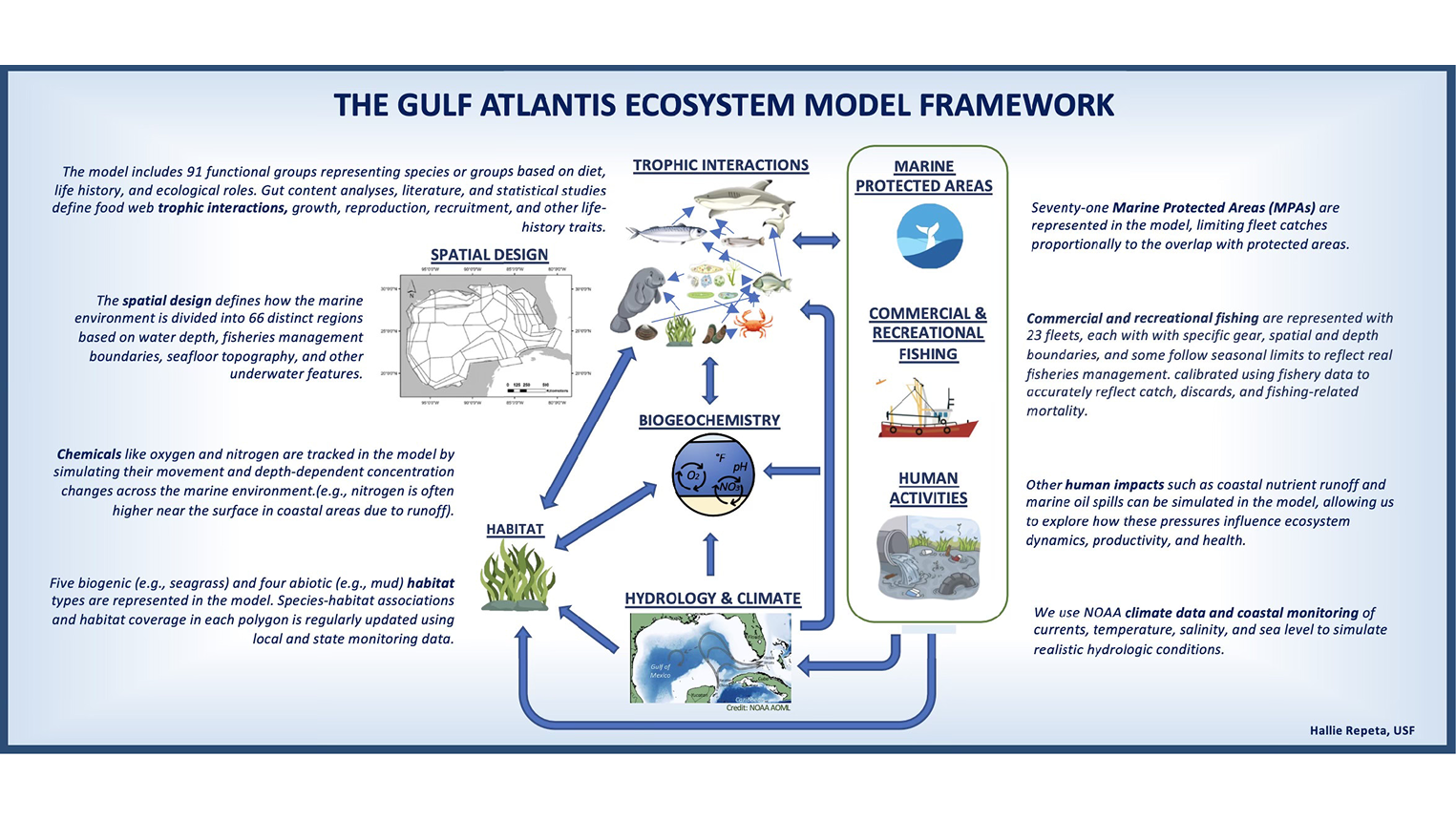
Infographic designed by Hallie Repeta.
THE GULF ATLANTIS ECOSYSTEM MODEL FRAMEWORK
Model Overview
The model includes 91 functional groups representing species or groups based on diet, life history, and ecological roles. Gut content analyses, literature, and statistical studies define food web trophic interactions, growth, reproduction, recruitment, and other life-history traits.
Spatial Design
The spatial design defines how the marine environment is divided into 66 distinct regions based on water depth, fisheries management boundaries, seafloor topography, and other underwater features.
Biogeochemistry
Chemicals like oxygen and nitrogen are tracked in the model by simulating their movement and depth-dependent concentration changes across the marine environment (e.g., nitrogen is often higher near the surface in coastal areas due to runoff).
Habitat
Five biogenic (e.g., seagrass) and four abiotic (e.g., mud) habitat types are represented in the model. Species-habitat associations and habitat coverage in each polygon is regularly updated using local and state monitoring data.
Hydrology & Climate
We use NOAA climate data and coastal monitoring of currents, temperature, salinity, and sea level to simulate realistic hydrologic conditions.
Human Impacts & Management
- Marine Protected Areas (MPAs): Seventy-one MPAs are represented in the model, limiting fleet catches proportionally to the overlap with protected areas.
- Commercial & Recreational Fishing: Represented with 23 fleets, each with specific gear, spatial and depth boundaries. Some follow seasonal limits to reflect real fisheries management, calibrated using fishery data to accurately reflect catch, discards, and fishing-related mortality.
- Human Activities: Other human impacts such as coastal nutrient runoff and marine oil spills can be simulated in the model, allowing us to explore how these pressures influence ecosystem dynamics, productivity, and health.
Credit: Hallie Repeta, USF
An integral part of my research involves examining nearly two decades of predator-prey diet data collected by the FWC Fish and Wildlife Research Institute’s Fisheries-Independent Monitoring Program. This long-term dataset provides a rare opportunity to examine feeding patterns across species, life stages, and habitats. By analyzing the diets of key forage fish and their associated predators, I examined whether diet patterns reflect behavioral refuge (feeding shifts to reduce predation risk), ontogenetic shifts (changes in diet due to life stage), or environmental drivers—and whether events like harmful algal blooms leave detectable signals and shifts in food web structure.
Building on this research, I am now using the Gulf Atlantis model to simulate how bottom-up environmental changes ripple through the food web and potentially shift system structure. After updating the model with the latest predator-prey interactions, I am testing various scenarios of nutrient loading and habitat change to assess how multiple drivers shape food web structure and resilience.
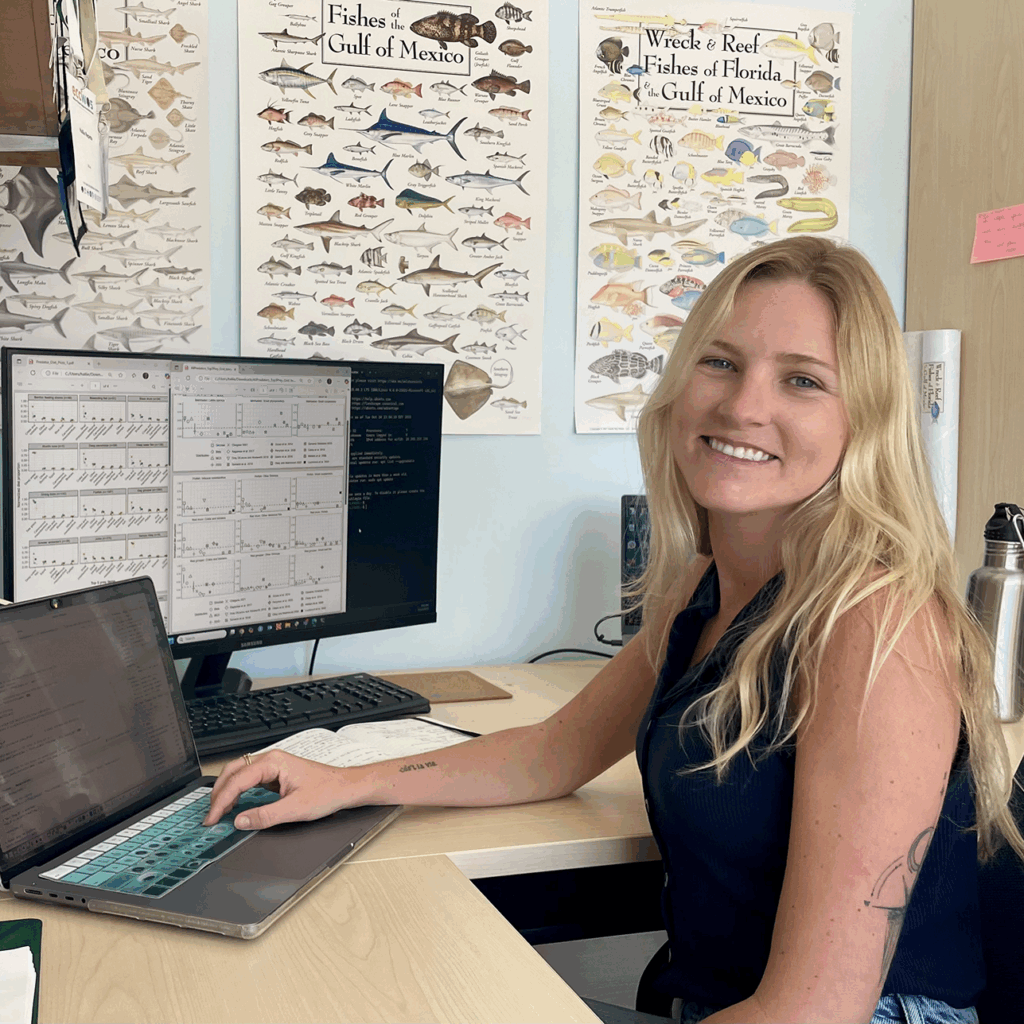
Repeta running code to model forage fish diets and predator-prey interactions in the Gulf. Photo by Hallie Repeta.
To evaluate system-wide effects, I’m pairing the simulations with Ecological Network Analysis (ENA), a framework that quantifies system level metrics in ecological networks. By leveraging Atlantis’ modeling capabilities together with ENA, these tools allow us to move beyond population-level projections and identify emergent properties such as the system’s resilience and ecological thresholds—points where small changes cascade into major ecological shifts. Although this research is still ongoing, preliminary results indicate that higher nutrient loading results in shifts in energy flow pathways within the estuary foodwebs.
Looking ahead, I plan to shift my focus toward management applications. By developing harvest control rules for forage fish or their key predators that integrate ecological considerations from my modeling work, I will use Management Strategy Evaluation to test how different strategies perform under future scenarios.
Forage fish may be small, but they carry enormous responsibility—fueling ecosystems from estuaries to the open ocean. By studying their diets, behavior, and responses to environmental stress, I aim to enhance our understanding of the mechanisms that sustain the resilience of our local ecosystems. Linking long-term datasets, ecosystem modeling, and network theory, my research seeks to provide insights that support climate-resilient, ecosystem-based management and advocate for stronger considerations of forage fish in management decisions across the Gulf. After all, managing forage fish is not only about conserving small fish—it’s about sustaining the entire food web, the fisheries, and the coastal communities that depend on them.
I am deeply grateful to Florida Sea Grant and the Guy Harvey Foundation for supporting the continuation of my research.