
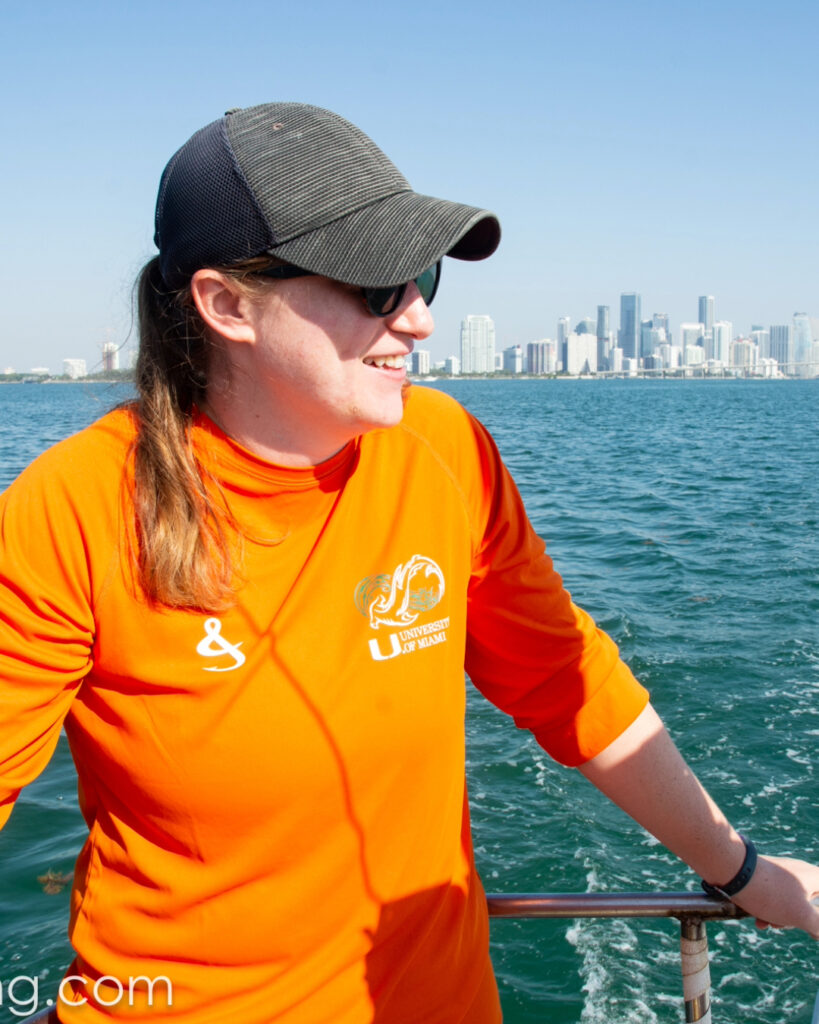
Image by Nola Schoder.
Emily Yeager is a PhD candidate in Environmental Science and Policy and a member of the Shark Research and Conservation Program at the University of Miami. She was awarded the Florida Sea Grant Guy Harvey Fellowship in 2025.
“Better stay close to shore,”
my dad said on a warm summer day in western Massachusetts. “There might be a shark in that river.” While, at the time, his words were meant as a cautionary tale to keep a younger me from swimming out too far into a local stream, today, they are increasingly ironic given the trajectory of my research career.
Growing up in New England, I developed a love for the ocean during summer vacations to Cape Cod. Time spent wandering out into the shallow waters and exploring tide pools scattered on rocks between long stretches of sandy beach, quickly turned into a fascination for the marine world and all of the life hidden beneath crashing blue waves. While these experiences first prompted my interest, it was a summer at The Island School in Cape Eleuthera, Bahamas that truly transformed that spark into a flame, and eventually a roaring fire during my undergraduate years at Wellesley College. Yet, despite this obvious love for the marine world, I often find myself surprised that I ended up in south Florida with the privilege of studying threatened sharks in the shadow of Miami.
Home to numerous residential and migratory shark species, Biscayne Bay is a critical habitat for the sharks and rays within it. This is especially true for the critically endangered Great Hammerhead shark—the bay is the first formally identified nursery for the species on the East coast of the United States. Subject to temperature and salinity changes due to river drainage and tidal influx and human pressures including pollution and recreational fishing, Biscayne Bay is a unique study site for assessing how organisms adapt to changing environments.
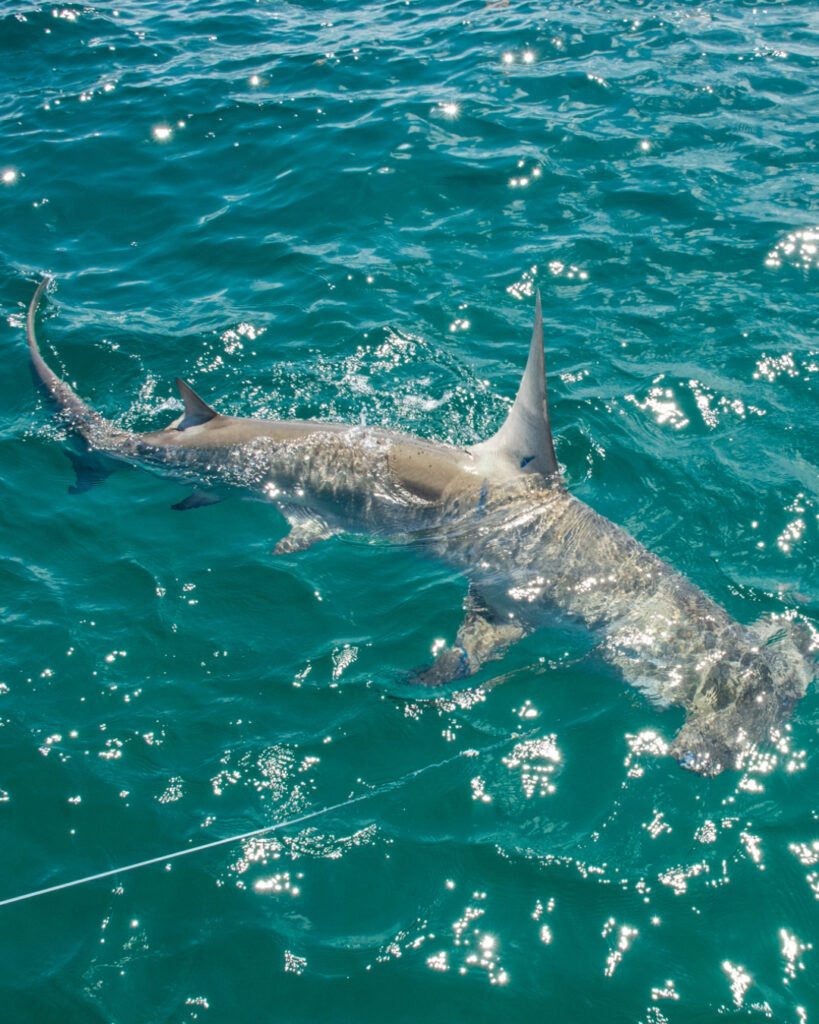
Image by Nola Schoder.
While my dad’s cautionary tale may have stemmed from fictitious beginnings, the threads underlying that tale are true. Sharks can swim up rivers and have even been documented doing so in the Mississippi River. Bull sharks in particular are at the heart of these stories, as adult females will travel up freshwater systems to give birth to their pups which only venture towards brackish, and eventually salty, water as they age. Bull sharks are able to travel into freshwater due to unique, osmoregulatory adaptations.
What is osmoregulation? How does it allow sharks to travel between different salinities andpersist in highly saline environments for most, if not all, of their lives?
Before we can talk about osmoregulation, we need to talk about osmosis. In its simplest form, osmosis is the process of water moving across a semipermeable membrane from areas with low amounts of salt (high water concentration) to areas with higher amounts of salt (low water concentration). Imagine placing a gummy bear in a cup of water. Over time, you’ll notice that the gummy bear will get bigger as water moves from the cup where there is a high concentration of water, across the semipermeable gelatin membrane into the gummy bear where the water concentration is lower.
Osmoregulation, on the other hand, is the process by which organisms balance the solutes (salts) in their body to match the salts of the environment around them. This prevents freshwater from leaving their bodies in very salty environments and freshwater from inundating their bodies in environments with very low concentrations of salt. Sharks are able to balance their salt concentration by creating and releasing a compound called urea. They create more urea when their environment becomes saltier and breakdown or release urea when their environment becomes less salty, allowing them to live in ocean environments with fluctuating salinity and to travel (in some cases) into more brackish or even freshwater environments.
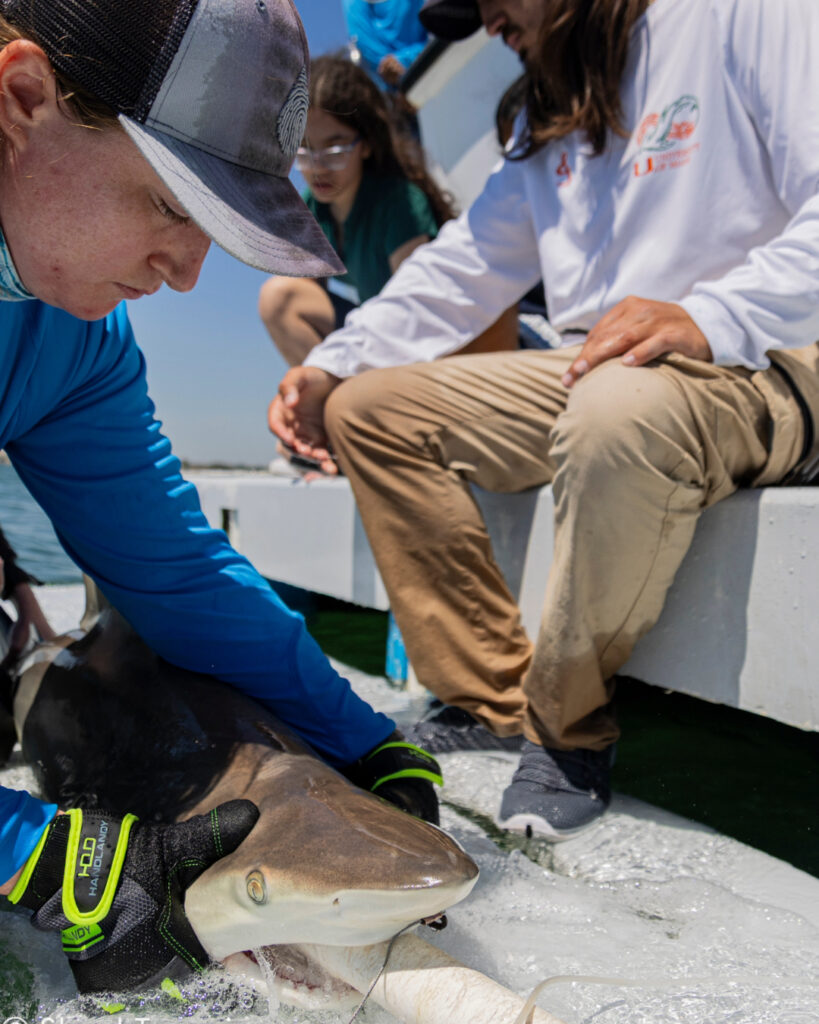
Image by Jason Hill.
While researchers know that sharks osmoregulate and know about the mechanisms of osmoregulation, very little was known about elasmobranch plasma urea concentrations and urea loss in wild-caught sharks prior to my team’s work in Biscayne Bay.
Interestingly, this whole project emerged from a passing thought my mentor, Dr. Catherine Macdonald, had while out on a field day. After working up a blacknose shark and sending it on its way, Dr. Macdonald said in passing that some sharks she works on just smell remarkably like urea—a potent, hard-to-describe but unmistakable aroma:“Like pee from someone dehydrated”. That comment stuck with me, and, over the next few months, I researched relentlessly until I had a strategy for studying plasma urea concentrations across shark species and the loss of urea across the gill membrane.
Understanding urea concentration and the process of urea loss, and how loss relates to secondary factors like salinity, temperature, and stress factors (such as lactate) may provide a baseline for understanding shark osmoregulatory physiology and how osmoregulatory processes might be changing under climate and human-caused stress. Months of work later, my team and I are happy to say that, while we don’t have all the answers yet, we are making meaningful steps forward in understanding this cryptic aspect of shark physiology.
Although we are still working to finish up lab analyses, I am excited to be able to share a preview of what we’ve found so far: there appears to be meaningful variation in blood-urea and urea loss at the gills across species with particularly interesting trends in critically endangered great hammerhead sharks, tiger sharks, and bull sharks. We also found environmental salinity and temperature to drive some of the trends we observed.
While I may not be swimming away from any sharks in small, hometown streams anytime soon, I’m immensely grateful to Florida Sea Grant and the Guy Harvey Foundation for supporting my research to better understand these sharks, their physiology, and their response to change in local, south Florida habitats.
Interested in learning more? Stay tuned for an upcoming peer-reviewed publication further detailing Yaeger’s research results.