
Rainer Moy-Huwyler is a 2025 FSG Guy Harvey Fellow. Ph.D. biology student at Florida International University’s Department of Biological Sciences. His research focuses on the energy expenditures of fish in the Florida Keys National Marine Sanctuary under current and future climate scenarios.
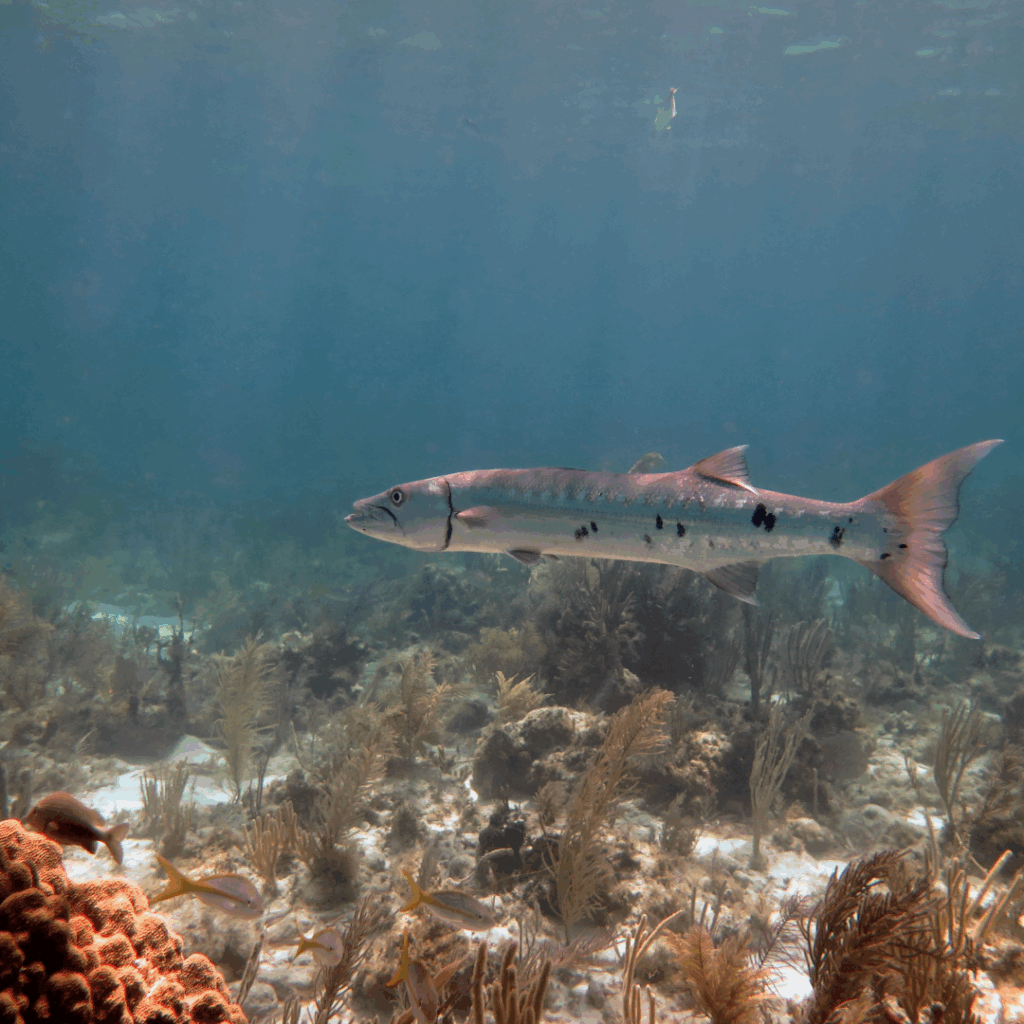
A barracuda swims over a patch reef in the Florida Keys, while smaller snapper move away quickly to avoid being near its jaws. Photo by Dr. Margaret Malone.
How does science connect the way elite athletes push their limits and wild animals fight for survival? As it turns out, many parallels can be drawn between how we think about and study these seemingly disparate groups.
These days, the value of exercise and activity is emphasized broadly across our daily lives, from professional sports to individual self-care. When I’m not out in the field or hammering away at analysis in the lab, I train a martial art called Muay Thai (also known as Thai boxing) to keep my body and mind well-tuned. As a combat sports athlete and graduate student in the thick of my doctoral research, I find myself contemplating the connections between these two oft-compartmentalized sectors of my life.
Imagine your favorite professional athlete at the pinnacle of their sport. They’re in peak physical shape: the product of constant conditioning, hours of training, meticulous coaching, and gallons of sweat exerted in pursuit of perfect performance. Beyond the gym or the training field, a significant portion of this performance relies on decades of sports science data informing how optimally the athlete should expend and consume energy. Even in my own athletic pursuits, I have worked closely with nutritionists and conditioning coaches who have greatly improved my output in the ring. The sound application of scientific expertise is key!
The field of animal physiology overlaps significantly with aspects of sports science, particularly those which quantify human energy usage and performance optimization. In fact, many of the methods used in both fields share the same principles and procedures! After all, we humans are animals that eat and move like any other.
Factors such as activity rates, lifestyle, temperature, and size play significant roles in the level of performance and metabolism. For instance, a large, active hunter such as a blacktip shark will have different energetic requirements from a smaller, more residential white grunt. Similarly (albeit on a human level), a triathlete may need to fuel themselves differently than a baseball player. The different requirements for each individual can be inferred from their respective metabolic rates and “energy budgets”, a term used to describe an organism’s flow of energy intake versus expenditure and how much energy is used for each aspect of its life.
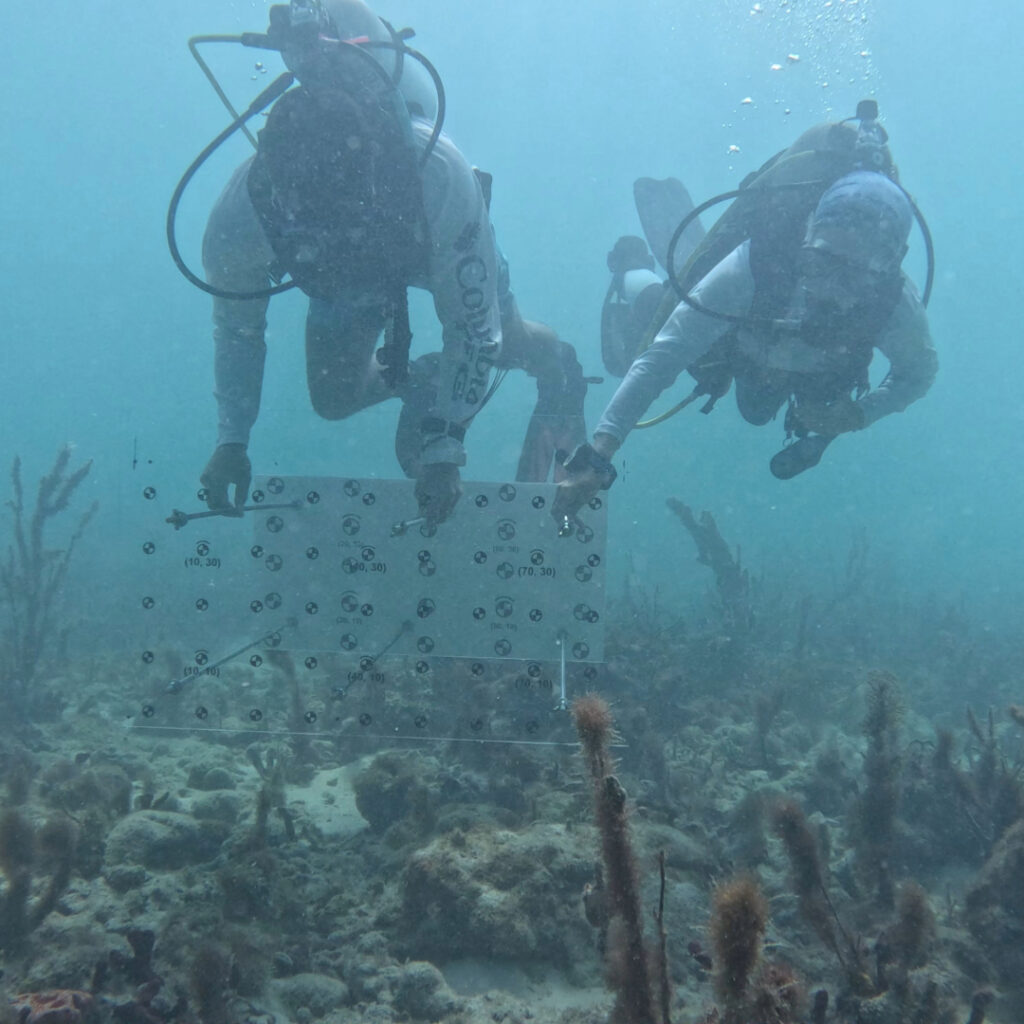
Divers bring a specialized calibration frame within view of a stereo-video camera system, used to sync recorded footage for three-dimensional measurement of wild swimming activity. Photo by Rainer Moy-Huwyler.
My work studying the physiology and energetics of fishes builds upon foundations set by decades of work in a field broadly referred to as metabolic theory. This theory revolves around a tenet which states that, fundamentally, all life is governed by metabolic rates. Since nearly all organisms utilize the same basic biochemical pathways for metabolism, it is colloquially termed the universal currency or “fire of life”. Metabolic rate determines each organism’s rate of energy intake and growth. It provides a baseline from which we can make comparisons within and between species, including humans. Metabolic theory is a cornerstone of animal physiology, allowing for a more robust understanding of the driving forces responsible for animal behavior as well as biotic and environmental interactions.
To quantify the energy expenditure of several different fish species, I combine several methods. The first is called intermittent-flow respirometry: I seal a fish inside of a chamber that measures the rate of oxygen consumption and then control the flow of water to make that fish swim at a specific speed – not unlike how a top marathoner might undergo VO2-max testing on a treadmill to determine their energy efficiency at differing levels of intensity. Respirometry can be combined with other techniques like accelerometry and acoustic telemetry to shed light on how animals expend energy in the wild and what effect their energy usage has on their behavior. Accelerometer-transmitter tags measure the body movement and position of free-moving animals in their environment, similar to how a fitness tracker can track a runner’s pace and route.
Whereas with athletes we care about the degree to which an individual can run, jump, lift, throw, or strike, with animals we tend to broaden our scope. Physiological and behavioral ecologists (particularly those who apply their knowledge to inform conservation and management) concern themselves with the degree to which a population consumes and expends energy. For example, we might ask: how much energy do mutton snapper in the Florida Keys expend on their long migrations to offshore spawning grounds near the Dry Tortugas? Once we know how much energy they use to swim that distance, we can begin to calculate their energy budgets and consumption rates, which informs us on the habitat resources required to sustain that wild population or valuable fishery. We can then share that knowledge with local- and state-level natural resources agencies and organizations to build comprehensive management plans that enable sustainable use and harvest for the future.
My research revolves around these types of questions. Mesopredator species such as white grunt, yellowtail snapper, mutton snapper, and barracuda play a role as both predator and prey in the Florida Keys. Therefore, data gathered on those species may serve as representative of a broad range of similar fishes in the same environment. By quantifying how much energy a population uses in the wild, I can model the amount of habitat-derived resources that it might need to grow or sustain itself and generate a theoretical carrying capacity. As conditions change over time, this model can be adjusted to reflect resource availability or increases in temperature.
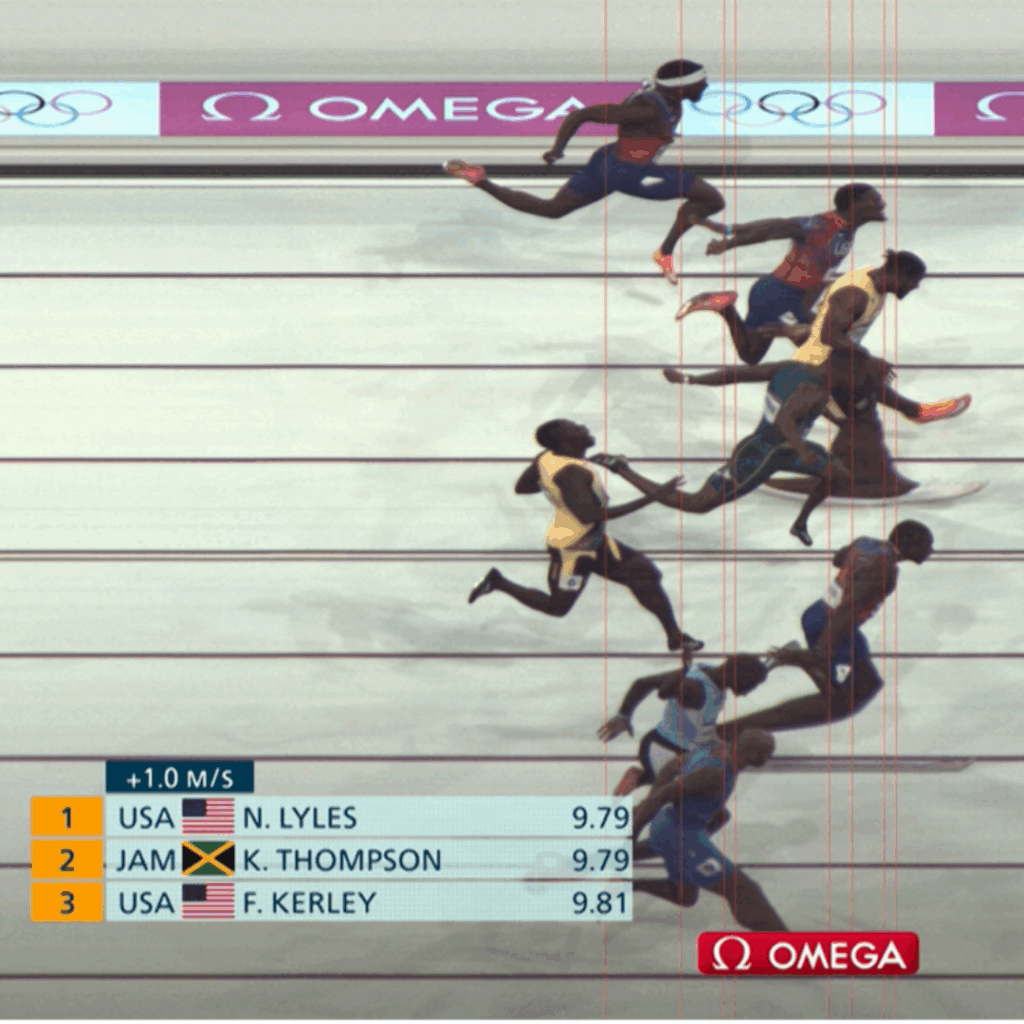
Noah Lyles (third from bottom) wins Olympic gold, with his exact finishing time and position recorded using ultra-high speed photogrammetry. Photo from Getty Images.
Furthermore, just as technological advancements aid in the accuracy and precision with which athletes are measured and coached, so too do they enable the collection of data at finer resolutions in the wild. Last year during the 2024 Summer Olympics in Paris, the prodigal American sprinter Noah Lyles and Jamaica’s Kishane Thompson faced off in the 100-meter race. The two battled to a near-identical superhuman finish time of 9.79 seconds, imperceptibly close for the human eye to distinguish. What determined the difference between gold and silver was a cutting-edge camera system that isolated the millisecond when Lyles’ chest crossed the finish line, a hair’s breadth ahead of Thompson. Although I do not (yet) have access to the proprietary high-speed motion capture technology used in the Olympics, I can apply a similar video-measurement concept in the field. The technique I use, broadly termed “videogrammetry”, uses carefully calibrated, synchronized cameras to generate three-dimensional measurements of speed and acceleration. In doing so, I can capture and quantify the pace of ecological interactions as they occur.
Using videogrammetry, I can extrapolate the amount of energy that fish use to avoid predators based on how quickly they react and swim away from an approaching predator stimulus, which in my case is a lifelike barracuda model. This allows for an even greater level of insight into the behaviors and activities that result in the expenditure of energy and subsequent consumption of resources in every day of these animals’ lives.
Ultimately, the athlete’s pursuit of excellence and a fish’s struggle to survive each might not be the perfect reflection of the other. Nonetheless, thanks to the universality and interdisciplinary nature of science, parallels exist in the way we study the two. The next time you tune in to your favorite sport, think about all the scientific developments that have led to the cultivation of that athletic prowess and consider how they can be applied to study our natural world. In doing so, recognize how the same physiological principles that drive human achievement also shape the ecological interactions of wild animals, providing yet another connection between humanity and the world we inhabit through a shared language of energetic flux.