
Lillian Bradshaw is a Ph.D. student from St. Louis, Missouri, pursuing a doctorate in ecology and evolution at Florida State University’s Department of Biological Sciences. She is a 2025 FSG- Guy Harvey Foundation Fellow, with her research focusing on studying the spatial distribution of human activity in the Florida Keys National Marine Sanctuary.
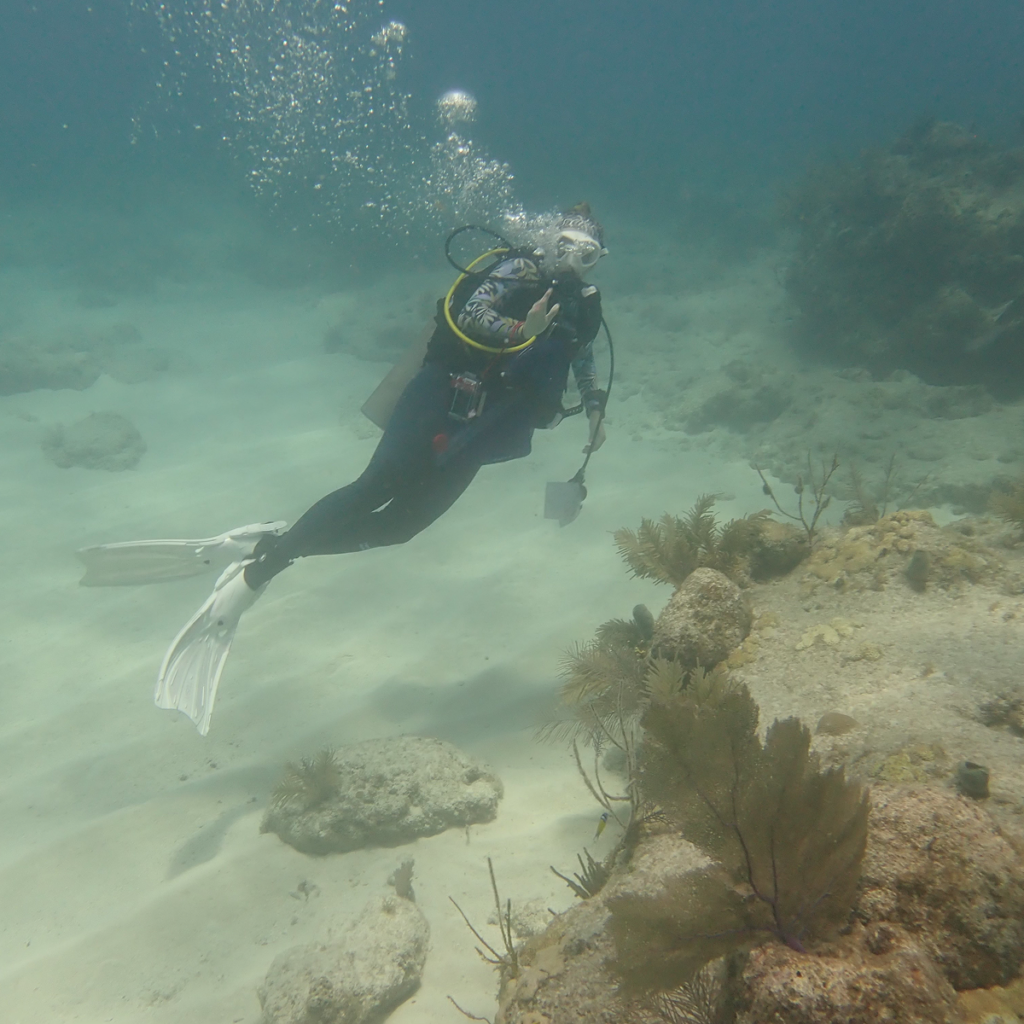 I grew up about as landlocked as you can get in St. Louis, Missouri, a minimum of 14 hours from any ocean. While other aspiring marine biologists were out snorkeling, my ‘fieldwork’ consisted of hiking, floating down spring-fed rivers, and exploring Forest Park. This love for being outside led me through a wide range of disciplines, including freshwater environmental toxicology, fish biology, recreation management, and environmental policy, giving me a unique perspective on how we study, manage, and protect our natural resources.
Each of these experiences taught me how humans interact with natural systems and the role that science plays in understanding them. I also learned that science alone does not protect ecosystems ; governance, policy, and collaboration do. When I found my way to marine ecology, I knew I wanted to work at the intersection of research and policy. Today, my work sits in two places: understanding coral reef ecosystem decline and changes in the number and types of animals in Florida’s Keys, while simultaneously exploring how effective aquaculture policy can be implemented to promote both ecosystem protection and long-term food security.
The ocean is a vital and critical ecosystem, providing services like food, storm protection, as well as economic and cultural value. In Florida, an iconic example is the Florida Keys. Home to the only barrier coral reef in the continental United States (the Florida Reef Track -FRT); this region has been protected by the Florida Keys National Marine Sanctuary (FKNMS) since 1990. Aside from its beauty, the region is immensely ecologically and economically important. Ecologically, the sanctuary offers protection to roughly two-thirds of the FRT, extensive seagrass beds, mangrove-fringed islands, more than 6,000 marine species, and culturally important shipwrecks. Economically, this region supports a massive tourism industry, valued at $2.4 billion annually, supporting 44% of employment in Monroe County.
Unfortunately, the outlook for the Florida Keys is particularly stark. Despite its longstanding protection status, the region has suffered devastating impacts from accelerating climate change. Declining coral cover has been an issue in the region since the 1970s when the first observations of bleaching and disease outbreaks were recorded. Since then, the region has experienced multiple major bleaching events, a cold water anomaly, multiple hurricanes, and a devastating disease outbreak of Stony Coral Tissue Loss Disease. These cumulative pressures have resulted in a loss of nearly 90% of stony coral cover over the last five decades.
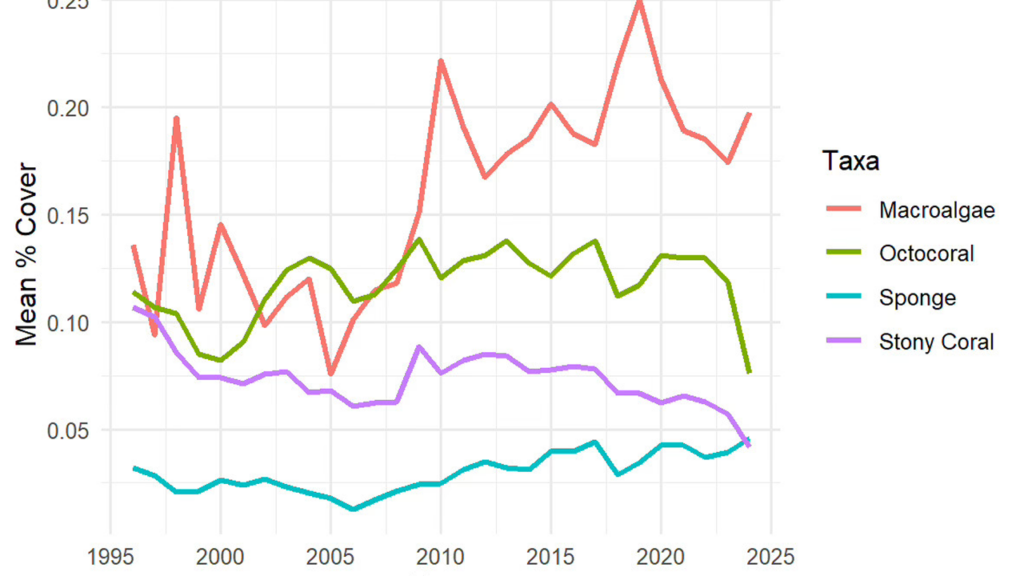
Graph depicting the decline in percent coral cover and changes in percent cover by taxa from 1996 – 2024. Data in this figure was collected by FWC CREMP starting in 1996, after the significant declines shown in figure 1.
Graph Breakdown: Mean Percent Cover (1996–2024)
This line graph tracks the mean percentage of reef coverage for four distinct biological groups over a 28-year span.
Key Trends by Group:
- Macroalgae (Pink Line): Highly volatile. Starts at roughly 13% in 1996, experiences sharp peaks in 1998, 2010, and reaches its highest peak near 25% around 2019. It ends at approximately 20% in 2024.
- Octocoral (Green Line): Starts around 11% in 1996, dips slightly until 2000, then steadily climbs to fluctuate between 12% and 14% for most of the 2010s. It drops sharply in the final years, ending near 8% in 2024.
- Stony Coral (Purple Line): Shows a long-term decline. Starts at over 10% in 1996, drops and stabilizes around 7% to 8% between 2000 and 2017, and steadily declines after 2017 to finish at its lowest point of roughly 4% in 2024.
- Sponge (Teal Line): Holds the lowest overall coverage. Remains relatively stable between 2% and 3% from 1996 to 2006, followed by a gradual upward trend to peak near 4.5% around 2017, ending at about 4% in 2024.
Data Intersections:
In 1996, Macroalgae, Octocoral, and Stony Coral all cluster closely together between 10% and 14% coverage. By 2024, Macroalgae clearly dominates the reef space, while Stony Coral and Sponge converge at the bottom around 4% coverage.
While much of the decline can be attributed to climate change, it is increasingly important to understand the contribution of local and regional non-climate stressors, like fishing, diving, and pollution. This is where the first half of my research sits: quantifying the roles these stressors play in shifting coral and fish community compositions over time and space, and determining how they exacerbate extreme climate events, like the 2023 heatwave. To do this, I utilize data from multiple sources, including multiple long term monitoring programs run by Florida Fish and Wildlife Conservation Commission (FWC).
While my work is ongoing, the results will help identify which stressors matter most, how they interact, and where management interventions can be most effective. However, understanding the problem is only part of the solution. While it is important scientists continue to monitor these ecosystem changes, knowledge alone cannot save a reef, we must also address the underlying pressures driving these losses. This realization is a catalyst for the second half of my work, moving beyond the ‘what’ of ecosystem collapse to the ‘how’ of policy-driven management.
As seafood demand continues to grow globally, sustainable aquaculture has enormous potential to meet that demand without relying on already exploited wild fish stocks. But, translating that potential into policy presents a complex challenge. Scientists and policymakers operate in different, yet parallel systems, separated by differing languages, timelines, and institutional constraints. Bridging that gap requires intentional collaboration and tools that make information accessible.
My research focuses on policies that encourage restorative aquaculture, defined as commercial or subsistence aquaculture that provides ecological benefits while simultaneously supplying seafood and economic opportunities. As part of a broader partnership with the National Sea Grant Law Center that aims to bridge gaps with state policymakers, I’m identifying current policies and pathways for states to implement new regulations and programs. This collaboration has produced tools like the State Marine Aquaculture Policy Dashboard and holds workshops that bring together federal and state managers, scientists, and extension agents. By transforming dense policy data into accessible and interactive tools, we help decision-makers understand their own policy landscape, learn from other states, and identify feasible solutions for promoting sustainable aquaculture in their states.
My work across coral reef ecology and aquaculture policy has taught me that understanding ecosystem decline is only part of the equation. Lasting solutions require science and policy working together, not separately. When both sides understand each other’s constraints and possibilities, we can build a more resilient future for our reefs, our food systems, and the communities that depend on both.
I’m eternally grateful to the Guy Harvey Foundation and the Builders Initiative for supporting this work, for funding research that bridges ecology and policy, and for believing that the solutions we need require scientists and policymakers thinking together.