
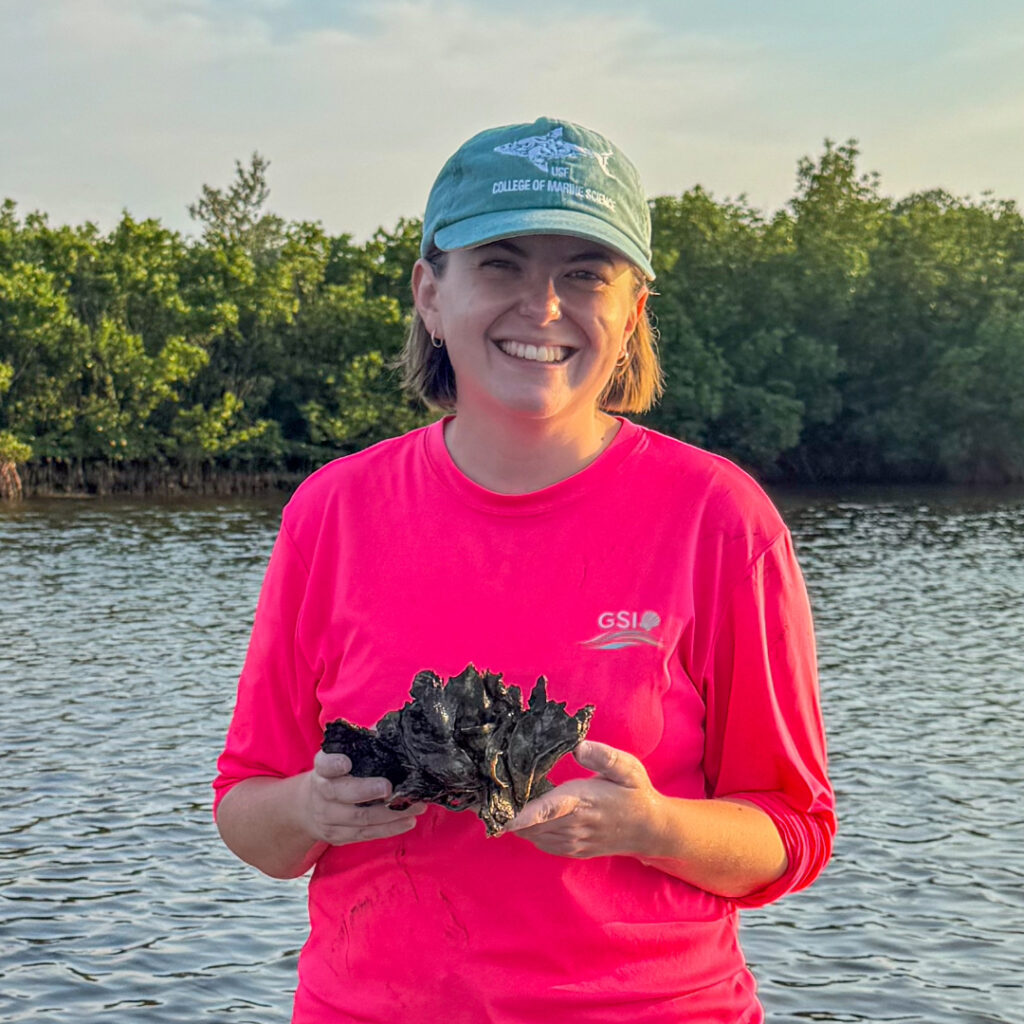
 Olivia Blondheim is a doctoral candidate at the University of South Florida College of Marine Science. She also serves as the Scientific Outreach Coordinator at the Gulf Shellfish Institute. Olivia was awarded the Aylesworth Scholarship in 2024.
What do you imagine when you think of the world’s most threatened ecosystem? Though many people probably think of images of corals bleached ghostly-white or chainsaws cutting through rainforest trees, oysters tell a quieter, but equally alarming story.
When I first started at the University of South Florida College of Marine Science, I knew little about oysters and their important role in marine ecosystems. During the first two years of my doctoral program, I spent considerable time in the field exploring various research directions to determine the focus I wanted to pursue for the remainder of my Ph.D. Whether I was wading through the salt marshes in Cedar Key or kayaking at Weedon Island, oysters were always there, it just never occurred to me to study them.
That changed when I was invited to help with the Gulf Shellfish Institute’s scientific diving operations for a research project focused on clam and seagrass co-restoration in Sarasota Bay. Learning first-hand about how bivalves, such as clams and oysters, can help improve our marine ecosystems while supporting the aquaculture industry inspired me to start digging deeper into what we still had yet to learn about oysters.
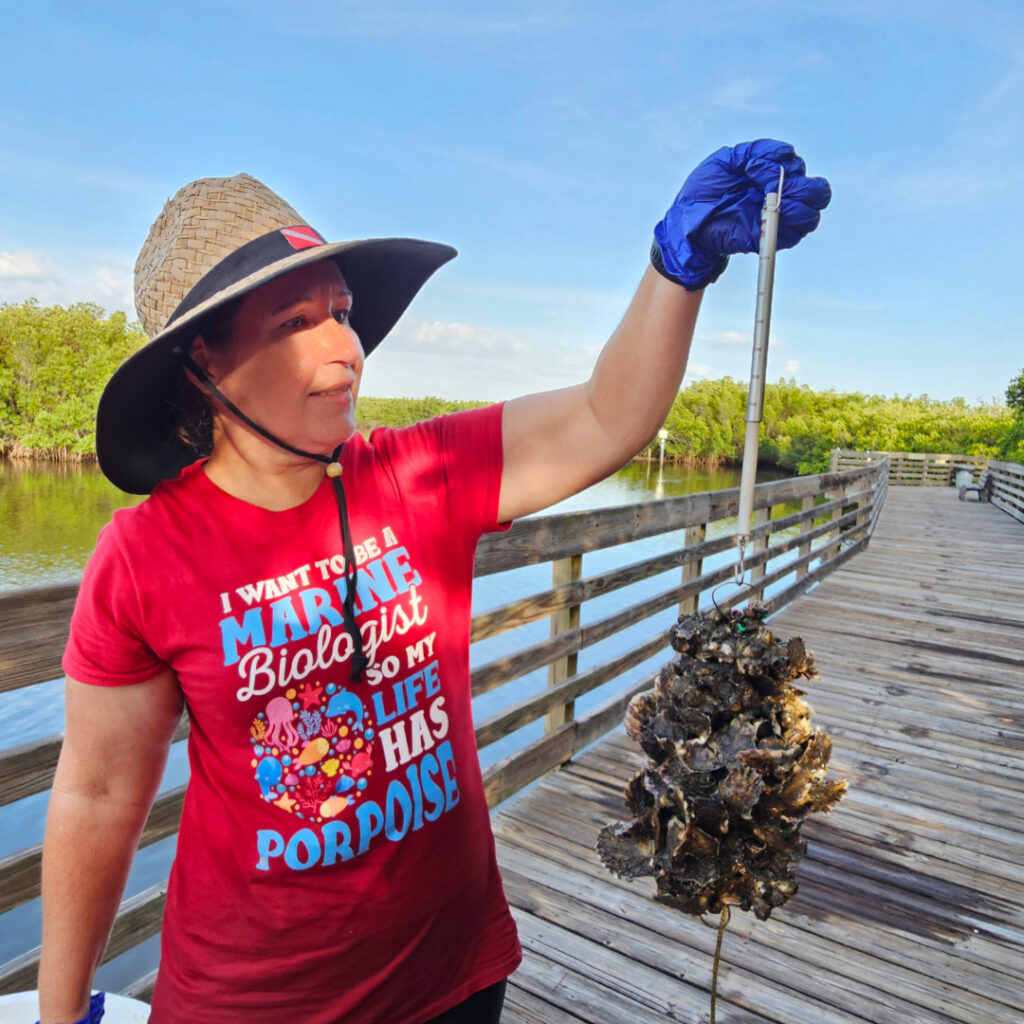
A volunteer helping measure the wet weight of a vertical oyster garden (VOG). Image by Olivia Blondheim.
Oysters are a keystone species that help clean and remove nutrients from the water, stabilize and protect shorelines from wave energy, and provide habitat structure for species such as fishes, birds, and invertebrates (crabs, conch, shrimp, barnacles). A recent study found that oyster reefs can help reduce wave energy by up to 40%, which is especially important for those of us who live in hurricane territory. Oysters are not just ecologically important, they are economically valuable, too. Oyster reefs can deliver services worth $5,500 to $99,000 per hectare annually (excluding the value of harvested oysters).
For me, oysters became the perfect avenue for me to combine all of my interests – scientific research, restoration, and community engagement – to help expand oyster ecosystem services in Tampa Bay.
Over the past 130 years, approximately 85% of oyster populations have been lost globally due to overharvesting, habitat loss, poor water quality, and disease. In Tampa Bay, the largest open-water estuary in Florida, oyster populations have experienced similar declines. Despite having a productive commercial oyster fishery in the late 1800s, dredging of oyster reefs for construction materials (limerock) led to a significant loss. Today, approximately 6-8% of historic oyster populations remain in Tampa Bay. While there is no active oyster fishery in Tampa Bay today, major efforts are underway to restore oysters in this urban estuary.
To help restore the ecosystem services that oysters provide to Tampa Bay, local organizations have prioritized oyster restoration in their management plans. This includes placing hard substrates, such as mesh bags of recycled or fossilized oyster shell or concrete oyster reef balls, into the water for the oyster larvae to settle and grow on. Another increasingly population restoration tool are vertical oyster gardens (VOGs), which are recycled oyster shells strung together on a rope or wire and then deployed from a dock or seawall. The VOGs serve as oyster ‘apartment buildings,’ where oyster larvae will settle and then grow into adult oysters.
One of the many benefits of this restoration tool is that anyone can ‘adopt a VOG,’ which allows oysters to be restored to hardened, privately-owned shorelines. This allows community members to be directly involved in restoring oysters in their own backyard. Despite the popularity of this community-led initiative, one challenge is that there have been no studies that have evaluated the ecosystem services that oysters provide on these hard substates compared to oysters on natural substates, like oyster reefs and mangrove prop roots.
For my research, I am particularly interested in oyster water filtration. One individual oyster can filter up to 50 gallons of water a day! Yet, most oyster filtration studies have been conducted in laboratory settings where oysters are fed a known amount of phytoplankton (algae – their food) and in ideal environmental conditions.

Measuring the water filtration of oysters on a mangrove prop root. Image by Olivia Blondheim.
My research aimed to build on the few studies that have been conducted in the field by merging the best of both worlds – natural phytoplankton and environmental conditions with an enclosed ‘chamber’ to monitor the oysters in. We achieved this by using two items that you may already have in your own backyard – a 20-gallon trash can and pool floaties. Usually the simplest solution is the best solution!
With the help of an amazing team of volunteers who braved thunder storms, a heat index many days over 100oF, and countless bug bites, we conducted our experiments at two different sites in Tampa Bay across the dry and wet seasons.
During each hour-long trial, oysters from each substrate (reefs, mangrove prop roots, and VOGs) were placed in separate buckets and water samples were collected at 20 minute intervals. At each time point, we passed the water through glass fiber filters to capture and concentrate the phytoplankton from the sample. Between both seasons, our volunteers collected 760 phytoplankton samples!
We also collected water samples to measure whether the number of bacteria changed in the bucket over time. These samples were then taken back to the laboratory at the University of South Florida College of Marine Science to analyze further.
Like plants, phytoplankton have pigments in their cells that help them capture energy from the sun and turn it into oxygen. Almost every phytoplankton species contains chlorophyll-a, which fluoresces a red light when blue light shines on it. We used a tool called a fluorometer to measure just how much red light is emitted in the water to determine the amount of phytoplankton in each sample. To tell us how much each oyster may be filtering during our experiments, we standardized the amount of water by the number and biomass of oysters that were in our buckets.
While I find immense joy in studying oysters and helping unveil the data that is needed for us to restore oysters to our estuaries, one of the greatest rewards has been the community of people that has come together around this important work. From the volunteers who have spent countless hours standing in waist-deep water collecting samples to the community members who have helped build VOGs at our outreach events, it has been incredible to see everyone unite over one goal – restoring oysters to our region. In the past two years, community members in the Tampa Bay region have helped build over 2,000 VOGs, which are being distributed to community members who will deploy them on their docks and seawalls.
For oysters, building a reef can take time as generation after generation of oysters grow on top of one another, creating a community of individuals that all do their own part to help clean and provide for our estuaries. Seeing each community member who engages with our research and outreach events reminds me of our reefs and gives me hope that one day, we will see our oyster populations restored to Tampa Bay.
To learn more about how you can get involved, visit: https://blogs.ifas.ufl.edu/pascoco/2025/04/16/vertical-oyster-gardens/
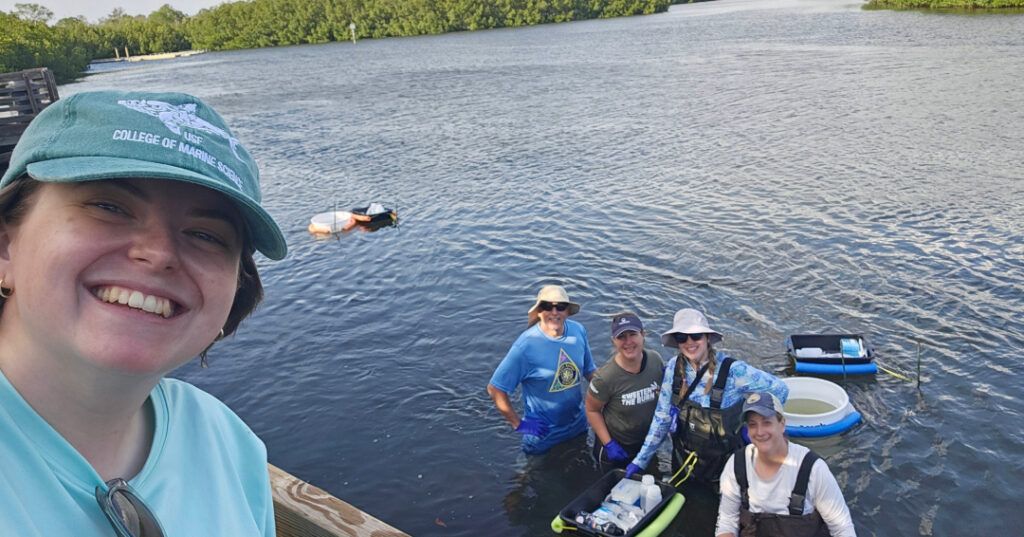
Volunteers helping with oyster water filtration experiments in Tampa Bay. Image by Olivia Blondheim.