
Document Download
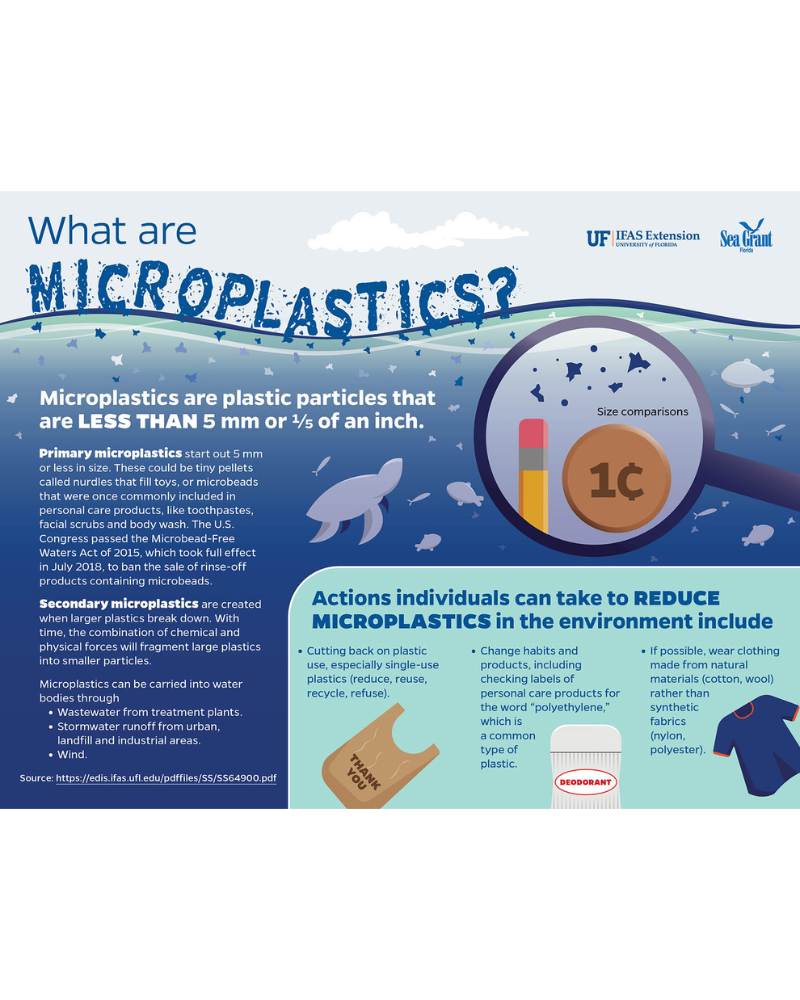
An educational infographic about microplastics co-branded by UF/IFAS Extension and Florida Sea Grant. The background is a blue ocean scene filled with fish silhouettes and tiny white particles representing microplastics.
Definition
Microplastics are plastic particles that are LESS THAN 5 mm or 1/5 of an inch. A circular inset diagram shows size comparisons of microplastics alongside a capsule pill and a one-cent coin.
Types and Sources
- Primary microplastics: Start out 5 mm or less in size. Examples include tiny pellets called nurdles that fill toys, or microbeads once commonly included in personal care products like toothpastes, facial scrubs, and body wash. Notes that the U.S. Congress passed the Microbead-Free Waters Act of 2015, which took full effect in July 2018 to ban the sale of rinse-off products containing microbeads.
- Secondary microplastics: Created when larger plastics break down. Over time, chemical and physical forces fragment large plastics into smaller particles.
- Transport Methods: Microplastics can be carried into water bodies through wastewater from treatment plants, stormwater runoff from urban, landfill, and industrial areas, and wind.
Actions Individuals Can Take to REDUCE Microplastics
- Cutting back on plastic use, especially single-use plastics (reduce, reuse, recycle, refuse). Accompanied by a drawing of a plastic grocery bag reading “Thank You.”
- Change habits and products, including checking labels of personal care products for the word “polyethylene,” which is a common type of plastic. Accompanied by a drawing of a deodorant stick.
- If possible, wear clothing made from natural materials (cotton, wool) rather than synthetic fabrics (nylon, polyester). Accompanied by a drawing of a blue t-shirt.
Source URL: https://ufl.edu