Header & Organization Information
STONY CORAL TISSUE LOSS DISEASE
Sub-title: Mitigating the Spread by Ballast Water Management
Logos present: USCRTF (United States Coral Reef Task Force), Florida Department of Environmental Protection Coral Reef Conservation Program, and Sea Grant Florida.
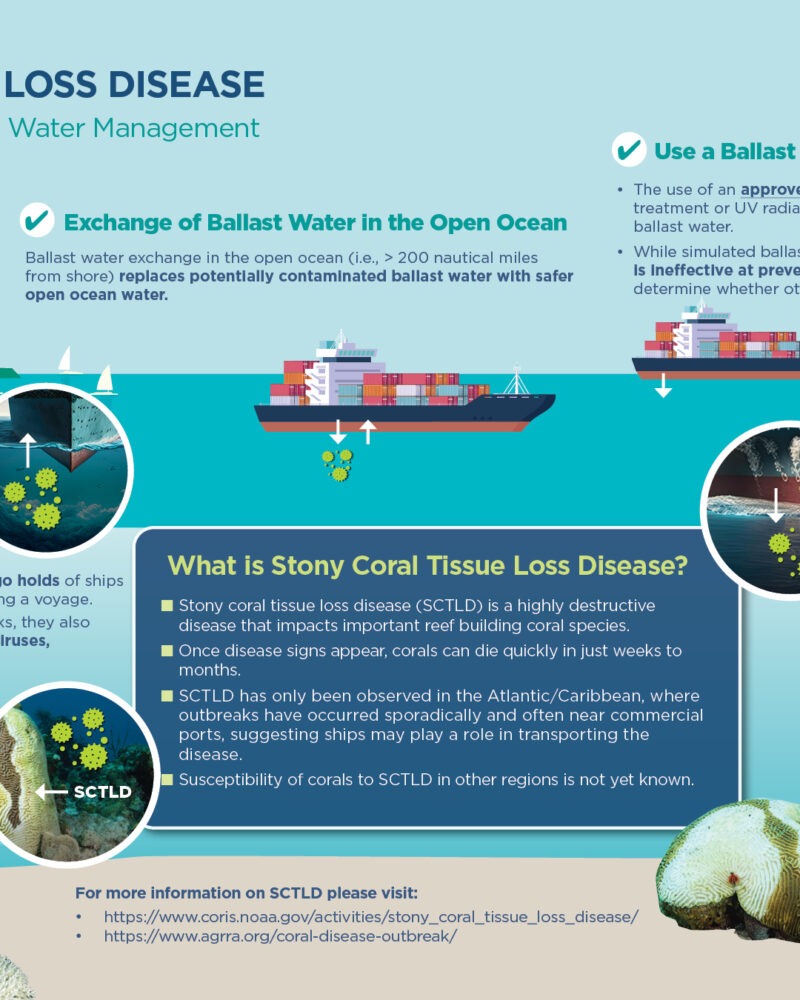
Central Informational Box: What is Stony Coral Tissue Loss Disease?
- Stony coral tissue loss disease (SCTLD) is a highly destructive disease that impacts important reef building coral species.
- Once disease signs appear, corals can die quickly in just weeks to months.
- SCTLD has only been observed in the Atlantic/Caribbean, where outbreaks have occurred sporadically and often near commercial ports, suggesting ships may play a role in transporting the disease.
- Susceptibility of corals to SCTLD in other regions is not yet known.
Four Core Ballast Water Management Practices
1. Avoid Uptake in Affected Areas (Marked with a Red X)
- Ballast water is seawater held in tanks and cargo holds of ships that provides stability and maneuverability during a voyage.
- When ships uptake seawater in their ballast tanks, they also take on microorganisms, such as bacteria and viruses, present in that water.
- Scientists don’t know what causes SCTLD, but currently believe microorganisms are involved.
- Ballast water sourced in regions impacted by SCTLD could potentially spread SCTLD to new regions.
- Visual graphic description: A diagram of a large cargo ship next to a magnified circle showing bacteria or virus cells under water. An arrow labels these cells as “SCTLD”.
2. Exchange of Ballast Water in the Open Ocean (Marked with a Green Checkmark)
Ballast water exchange in the open ocean (i.e., > 200 nautical miles from shore) replaces potentially contaminated ballast water with safer open ocean water.
Visual graphic description: A diagram showing a cargo ship in mid-ocean with dual arrows pointing down and up, indicating water discharging and flushing out from the vessel hulls.
3. Use a Ballast Water Management System (Marked with a Green Checkmark)
- The use of an approved ballast water management system, such as chemical treatment or UV radiation, can reduce the number of microorganisms in ballast water.
- While simulated ballast water experiments indicate that UV-treatment alone is ineffective at preventing SCTLD transmission, more research is needed to determine whether other systems can help prevent disease transmission.
- Visual graphic description: A diagram showing a vessel with a magnified circle illustrating a water filtration tube radiating purple UV-treatment rays onto passing microorganisms.
4. Do Not Discharge Ballast Water Near Coral Reefs (Marked with a Red X)
SCTLD is known to spread to healthy corals through contaminated seawater and sediment.
Visual graphic description: A diagram showing a ship discharging water directly over a coastal marine ecosystem filled with diverse corals and a fish swimming near the seabed.
Footer & Web Resources
For more information on SCTLD please visit:
- https://noaa.gov
- https://agrra.org