
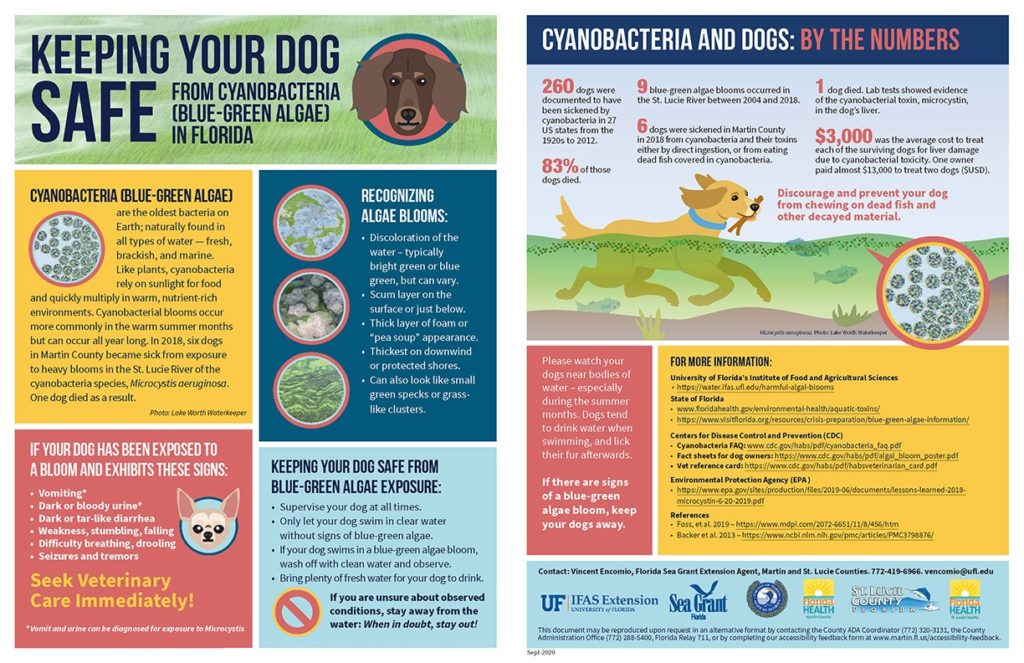
Detailed Transcript: Keeping Your Dog Safe From Cyanobacteria
Header and Overview
Title: Keeping Your Dog Safe From Cyanobacteria (Blue-Green Algae) in Florida. Features a photo of a dog in a lifesaver ring.
What is Cyanobacteria?
They are the oldest bacteria on Earth, found in fresh, brackish, and marine water. They multiply rapidly in warm, nutrient-rich environments. In 2018, six dogs became sick from exposure to Microcystis aeruginosa blooms in the St. Lucie River; one dog died.
Recognizing Algae Blooms
- Discoloration of water (typically bright green or blue-green).
- Scum layer on or just below the surface.
- Thick layer of foam or “pea soup” appearance.
- Thickest on downwind or protected shores.
- Can look like small green specks or grass-like clusters.
Symptoms of Exposure
If your dog exhibits these signs, seek veterinary care immediately: Vomiting, dark or bloody urine, dark or tar-like diarrhea, weakness, stumbling, falling, difficulty breathing, drooling, seizures, and tremors.
Prevention Tips
- Supervise your dog at all times.
- Only let your dog swim in clear water without signs of algae.
- If your dog swims in a bloom, wash them off with clean water immediately and observe them.
- Bring plenty of fresh water for your dog to drink.
- When in doubt, stay out!
- Discourage and prevent your dog from chewing on dead fish and other decayed material.
By the Numbers Statistics
- 260 dogs were documented to have been sickened by cyanobacteria in 27 US states from the 1920s to 2012. 83% of those dogs died.
- 9 blue-green algae blooms occurred in the St. Lucie River between 2004 and 2018.
- 6 dogs were sickened in Martin County in 2018 from cyanobacteria and their toxins.
- 1 dog died with evidence of microcystin in its liver.
- $3,000 was the average cost to treat each surviving dog for liver damage. One owner paid almost $13,000 to treat two dogs.
Contact and Resources
Includes contact info for Vincent Encomio, Florida Sea Grant Extension Agent (772-419-6966, [email protected]). Prompts users to visit resources from UF/IFAS, the State of Florida, CDC, and EPA. Features logos for UF/IFAS Extension, Sea Grant Florida, Florida Health, and Martin County.
By: Lourdes Rodriguez, 954-577-6363 office, 954-242-8439 mobile, [email protected]
Some dogs love to swim in the water, and some may even take a bite from fish they locate floating on the water’s surface. The danger comes when dogs are exposed to waters with blue-green algae that are emitting toxins. That blue-green algae, also called cyanobacteria, can release a toxin that produces harmful symptoms for dogs when ingested. Those symptoms can include vomiting, weakness, difficulty breathing, seizures, tremors, and in some cases can be fatal.
Florida Sea Grant, along with UF/IFAS Extensions in Martin and St. Lucie counties have partnered with the Department of Health to release a fact sheet in an effort to help consumers keep their canines safe when toxins are present in the waters. The fact sheet details the toxin’s effects on dogs, risks for fatality, how to recognize the presence of algal blooms, and links to additional resources.
“This fact sheet provides valuable information and resources for dog owners on the risks of a persistent and potentially growing problem affecting their family canine’s health when blue-green algae blooms are in the vicinity,” said Vincent Encomio, a Florida Sea Grant Extension Agent for both counties. “The intended audience is the general public, but we are taking first steps distributing this document to veterinary facilities in both counties.”
The fact sheet is also available for free by downloading from this Florida Sea Grant website link https://www.flseagrant.org/habs/
In 2018, six dogs in Martin County became sick from exposure to heavy blue-green algae blooms in the St. Lucie River. One dog died as a result.
“Based on a needs assessment I conducted in 2019, cyanobacteria blooms were the environmental issue of highest concern to the public on the Treasure Coast,” said Encomio. “Since then, I have been working on educational efforts to address these concerns.”
The infographic-styled fact sheet is one result of those efforts. For another free resource that dives a little deeper into the issue there is a 30-minutes webinar, Cyanobacteria, Public Health and Pets, presented as part of the ongoing Bite-Sized Science series by UF/IFAS Extension Florida Sea Grant agents and specialists.
While the reported numbers in Martin may not seem impactful now, the reality is that more wildlife fatalities are being reported each day showing signs of wildlife’s vulnerability to the harmful toxin’s effects that come with blue-green algae blooms. A 2013 study found that 27 states across the country documented that 260 dogs experienced some form of sickness by exposure to cyanobacteria from the 1920s to 2012. More importantly, the current state of Lake Okeechobee is something to worry about when it comes to toxins making their way into other nearby bodies of water.
“There’s a lot of concern in that Lake Okeechobee has had persistent blue-green algae blooms, some quite large, all summer. These events raise concerns that water releases could introduce blooms to the Caloosahatchee and St. Lucie. In Martin county, it seems as though we have been on a daily watch for Lake Okeechobee releases to the St. Lucie River,” said Encomio.
Lake Okeechobee water levels are currently over 15 feet, explains Encomio. Any future rain events, particularly a tropical storm could potentially push the Lake levels to 16 feet or higher. In that case, the Army Corps of Engineers are likely to release water from the Lake west to the Caloosahatchee River and east to the St. Lucie River, to protect the integrity of the Herbert Hoover Dike.
“As active a hurricane season 2020 has been so far, the threat of this scenario still remains,” he adds.
In 2016 extensive blue-green algae blooms spread throughout the St. Lucie River. In 2018, severe blooms occurred in both the Caloosahatchee and the St. Lucie rivers. There has been increased public awareness and concern of the health effects of toxic cyanobacteria blooms.