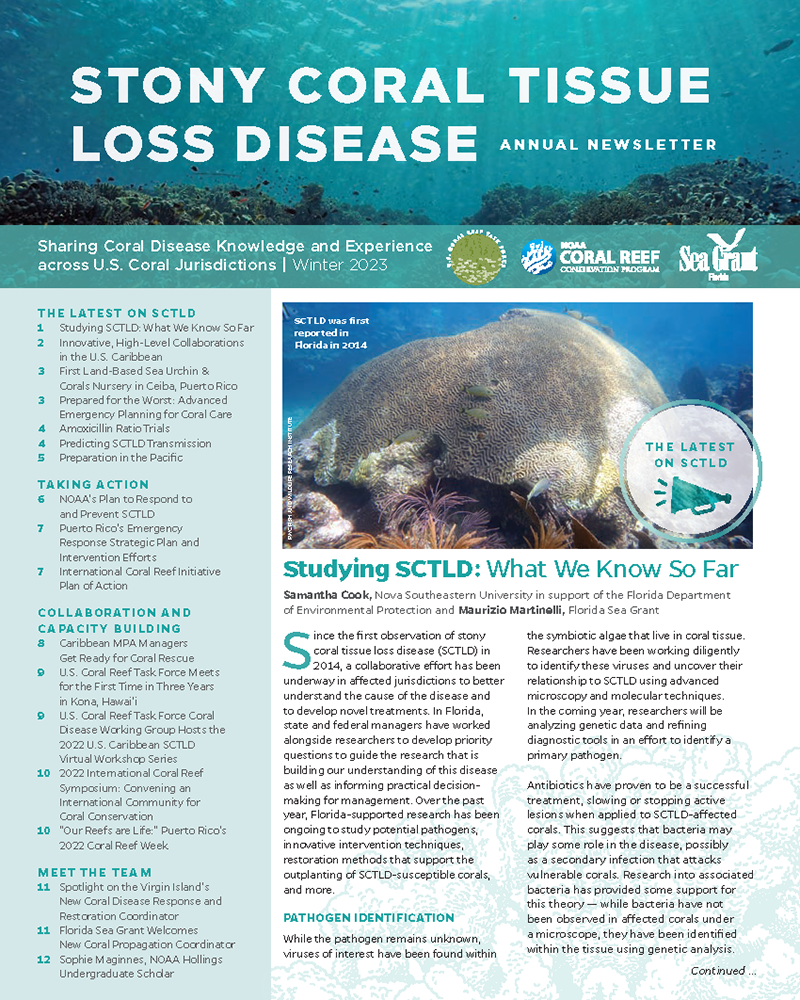
Header, Branding & Metadata
STONY CORAL TISSUE LOSS DISEASE ANNUAL NEWSLETTER
Sub-title: Sharing Coral Disease Knowledge and Experience across U.S. Coral Jurisdictions | Winter 2023
Logos present: Florida Department of Environmental Protection, NOAA Coral Reef Conservation Program, and Sea Grant Florida.
Callout Note: SCTLD was first reported in Florida in 2014.
Table of Contents (Left Sidebar)
THE LATEST ON SCTLD
- 1 Studying SCTLD: What We Know So Far
- 2 Innovative, High-Level Collaborations in the U.S. Caribbean
- 3 First Land-Based Sea Urchin & Corals Nursery in Ceiba, Puerto Rico
- 3 Prepared for the Worst: Advanced Emergency Planning for Coral Care
- 4 Amoxicillin Ratio Trials
- 4 Predicting SCTLD Transmission
- 5 Preparation in the Pacific
TAKING ACTION
- 6 NOAA’s Plan to Respond to and Prevent SCTLD
- 7 Puerto Rico’s Emergency Response Strategic Plan and Intervention Efforts
- 7 International Coral Reef Initiative Plan of Action
COLLABORATION AND CAPACITY BUILDING
- 8 Caribbean MPA Managers Get Ready for Coral Rescue
- 9 U.S. Coral Reef Task Force Meets for the First Time in Three Years in Kona, Hawaiʻi
- 9 U.S. Coral Reef Task Force Coral Disease Working Group Hosts the 2022 U.S. Caribbean SCTLD Virtual Workshop Series
- 10 2022 International Coral Reef Symposium: Convening an International Community for Coral Conservation
- 10 “Our Reefs are Life:” Puerto Rico’s 2022 Coral Reef Week
MEET THE TEAM
- 11 Spotlight on the Virgin Island’s New Coral Disease Response and Restoration Coordinator
- 11 Florida Sea Grant Welcomes New Coral Propagation Coordinator
- 12 Sophie Maginnes, NOAA Hollings Undergraduate Scholar
Featured Article
Studying SCTLD: What We Know So Far
By: Samantha Cook, Nova Southeastern University in support of the Florida Department of Environmental Protection and Maurizio Martinelli, Florida Sea Grant.
Since the first observation of stony coral tissue loss disease (SCTLD) in 2014, a collaborative effort has been underway in affected jurisdictions to better understand the cause of the disease and to develop novel treatments. In Florida, state and federal managers have worked alongside researchers to develop priority questions to guide the research that is building our understanding of this disease, as well as informing practical decision-making for management. Over the past year, Florida-supported research has been ongoing to study potential pathogens, innovative intervention techniques, restoration methods that support the outplanting of SCTLD-susceptible corals, and more.
Pathogen Identification
While the pathogen remains unknown, viruses of interest have been found within the symbiotic algae that live in coral tissue. Researchers have been working diligently to identify these viruses and uncover their relationship to SCTLD using advanced microscopy and molecular techniques. In the coming year, researchers will be analyzing genetic data and refining diagnostic tools in an effort to identify a primary pathogen.
Antibiotics have proven to be a successful treatment, slowing or stopping active lesions when applied to SCTLD-affected corals. This suggests that bacteria may play some role in the disease, possibly as a secondary infection that attacks vulnerable corals. Research into associated bacteria has provided some support for this theory — while bacteria have not been observed in affected corals under a microscope, they have been identified within the tissue using genetic analysis.
Continued…
Visual Graphic Description
An embedded underwater photo circle badge labeled ‘THE LATEST ON SCTLD’ displays a marine researcher collecting a scientific sample from a large brain coral colony submersed along the ocean floor.